
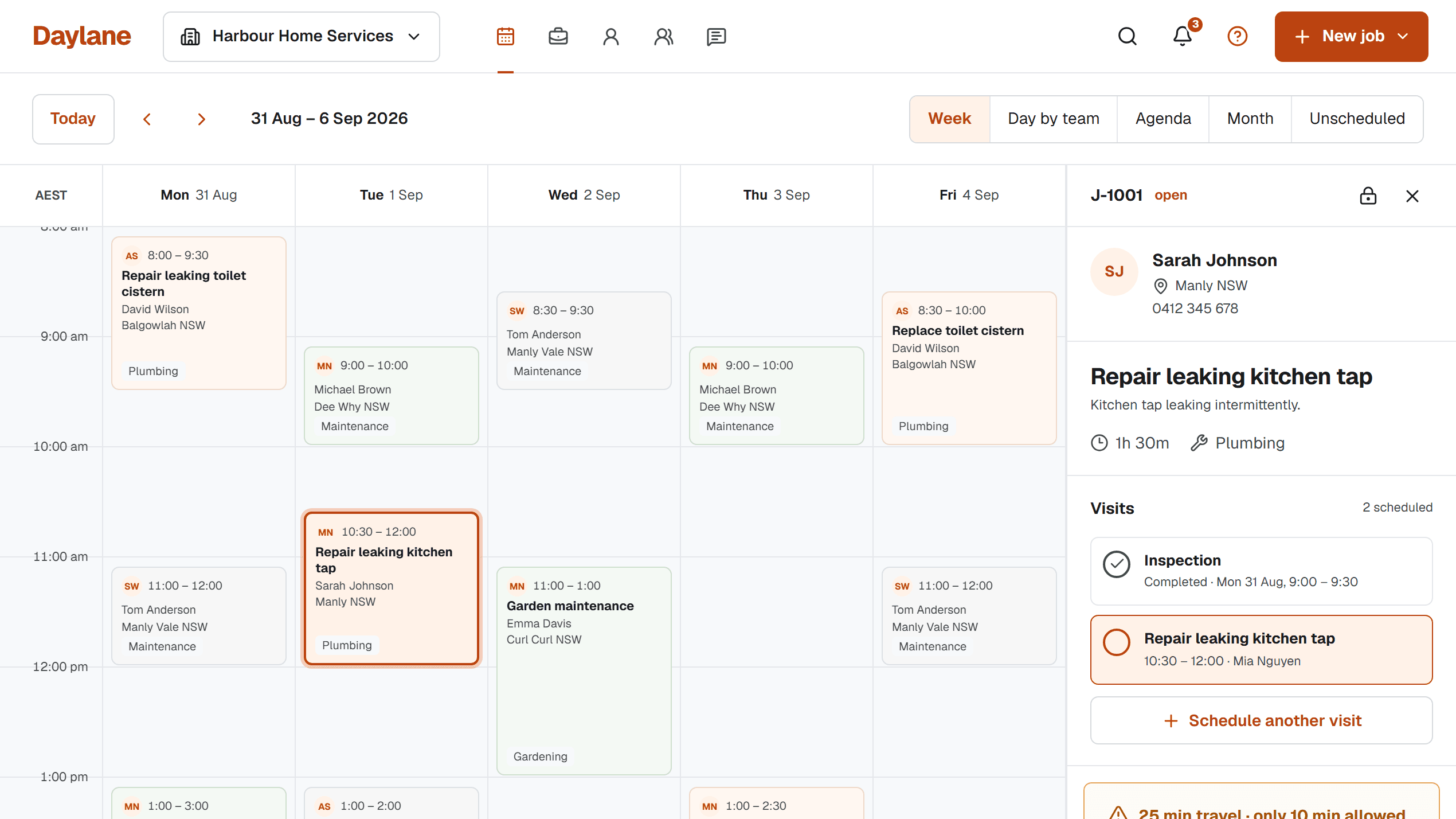
Review the next cycle of recurring work before accepting extra seasonal bookings. Check whether each customer's service still has the same scope, duration, access and attending person. Repeated calendar entries can look dependable even when their underlying assumptions have changed.
Use one readiness row per service relationship
Start with recurring services likely to compete for the same working days. The sample below is a manual review convention, not an automatic Daylane readiness score. Give every unresolved item an owner and decision date.
| Service | Changed assumption | Next action |
|---|---|---|
| North office clean | Reception now opens later | Scheduler to confirm a new arrival window |
| Courtyard gardening | Extra seasonal work requested | Estimate separately before extending the Visit |
| Site inspection | Usual assignee on leave | Check replacement availability and briefing |
Inspect occurrences as well as the pattern
Daylane generates separate Jobs in a rolling 90-day window. Review what is actually scheduled within that window and note later intentions separately. A year-long customer agreement does not mean every occurrence has already been generated.
Check moved or edited occurrences individually when revising a future pattern. Those Jobs can remain protected from the bulk change. Reconcile the schedule after saving rather than assuming the pattern summary describes every future Visit.
Reserve capacity after resolving the exceptions
Add travel, setup and likely seasonal duration changes to the occupied-time plan. Then compare the remaining capacity with one-off requests. Avoid counting a shared team Visit twice as customer work, while still reserving each person's time.
Before the busy period begins, confirm material changes with customers and assigned people. Keep a short open-exception list and review it until each item has a real outcome. A green-looking calendar is not evidence that access and scope have been reconfirmed.
Sources and scope
An original operational guide from the Daylane team at Blu Mint Digital. Scenarios, durations and message wording are illustrative planning examples, not customer results or industry benchmarks. Product references were checked against the Daylane implementation on 5 September 2026. Adapt the workflow to your service, customer agreements and working conditions.
How we write and maintain our guides. Free templates and planning tools.