
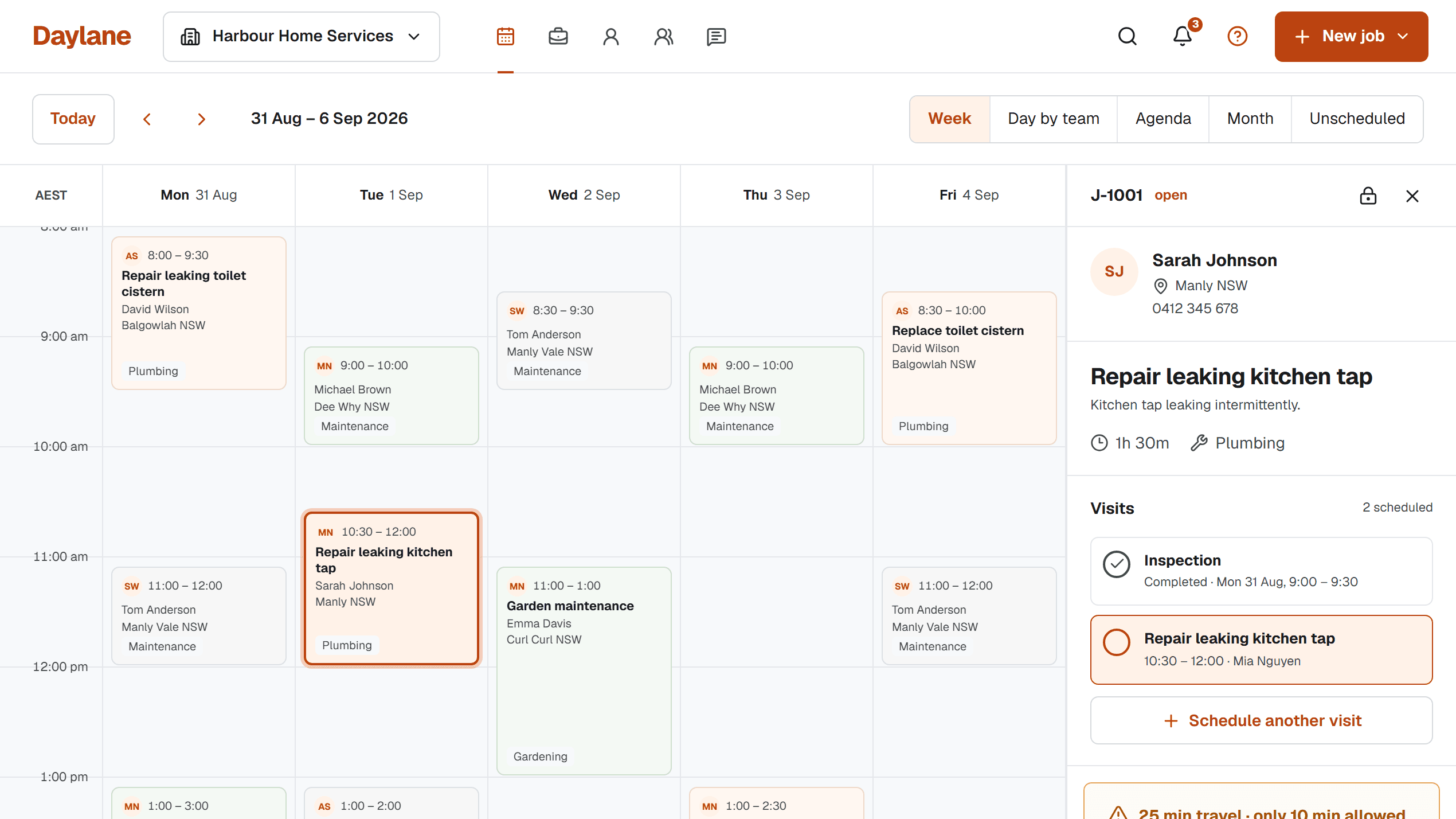
Use availability to describe when a person can work and Visits to describe customer attendance. A personal appointment does not need a fictional Customer or Job. Keeping the two separate makes the schedule easier to interpret and lets you review existing commitments when someone's working time changes.
Choose the right kind of record
In Daylane, team dispatch and Availability are Pro+ features. The team member's page provides working days and start/end times, plus an Add unavailable time form with start and end dates and times. A reason is optional. A short operational reason is usually enough; the scheduler needs to know the constraint, not private background.
| Situation | Record | Follow-up |
|---|---|---|
| Normal Monday, 08:00–16:00 | Working Availability | Use as the baseline |
| Appointment, Monday 13:00–14:00 | Unavailable time | Review travel on both sides |
| Customer inspection, Monday 10:00–11:00 | Scheduled Visit | Confirm scope and service Location |
Review existing Visits after blocking time
Adding unavailable time is not a rescheduling service. Inspect Visits that overlap the block and decide whether to move them or assign another available person. Then check adjacent travel; a Visit ending at 13:00 may still leave no time to reach a personal appointment beginning at 13:00.
Confirm any customer-facing change separately. Do not tell a customer that their Visit has moved until the new time has been saved and the relevant person is available.
Keep exceptions bounded
For a one-day change, use a dated block rather than rewriting the usual working week. For a lasting change, update the regular hours and review the future schedule. Verify the saved dates and time zone, especially for leave spanning several days.
Availability warnings help identify a conflict; they do not replace a decision about access, travel or the customer's promise. If you keep a warned time, record a concrete reason and verify the underlying arrangement.
Sources and scope
An original operational guide from the Daylane team at Blu Mint Digital. Scenarios, durations and message wording are illustrative planning examples, not customer results or industry benchmarks. Product references were checked against the Daylane implementation on 5 September 2026. Adapt the workflow to your service, customer agreements and working conditions.
How we write and maintain our guides. Free templates and planning tools.