
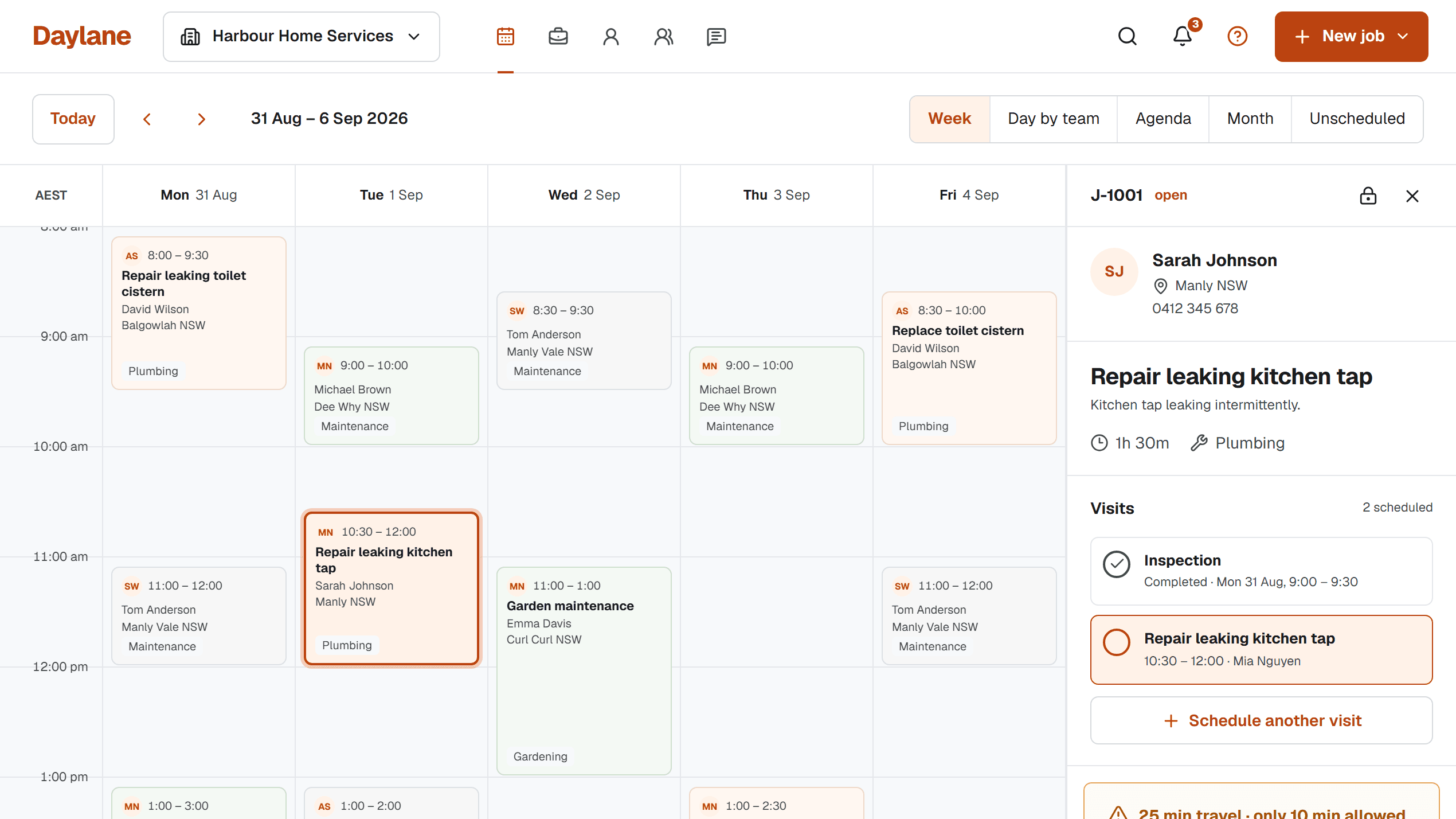
Plan the first day back around commitments you have verified, not every message that arrived while you were away. Reserve time to review pending requests and dependencies, check the customer Visits already agreed, and give unresolved work an owner. A crowded first morning can turn a manageable backlog into a week of rescheduling.
Separate commitments from requests
A message asking for Monday is not a Monday booking unless someone confirmed it. Review the source schedule and customer agreements before treating your inbox as a dispatch list. Check whether anyone covering the business made changes while you were away.
Identify promises to contact customers as well as actual Visits. A return enquiry that was awaiting a supplier answer may need a call before it can become an attendance.
Reserve a real review period
The fictional example below assumes an eight-hour working window. Its allowances demonstrate the effect of reserving time; they are not recommended work hours or a universal return-from-leave routine.
| Use | Minutes |
|---|---|
| Review changes and pending requests | 45 |
| Breaks | 30 |
| Admin and final travel | 45 |
| Recovery allowance | 45 |
| Remaining for Visits and inbound travel | 315 |
| Working window | 480 |
Recheck readiness for the confirmed Visits
Confirm that access, materials and the assigned people are still available. A booking made before leave may depend on information that changed during it. Start with the Visits whose failure would displace several other commitments.
For a parts-dependent return, verify readiness rather than assuming a previously estimated delivery has happened. Give the customer a clear update if the work cannot proceed as originally agreed.
Assign the backlog instead of absorbing it all
Group pending work by the next decision: needs details, needs approval, ready to schedule or no longer proceeding. Use explicit next actions such as 'confirm reception access Tuesday morning' rather than creating placeholder Visits to keep everything in view.
Offer additional work only after checking the actual day. In the sample, three Visits occupying 100 minutes each would use 300 of the 315 remaining minutes. A fourth would not fit. Use the first day's outcomes to plan the rest of the week, and revisit any customer contact you promised during the review.
Sources and scope
An original operational guide from the Daylane team at Blu Mint Digital. Scenarios, durations and message wording are illustrative planning examples, not customer results or industry benchmarks. Product references were checked against the Daylane implementation on 5 September 2026. Adapt the workflow to your service, customer agreements and working conditions.
How we write and maintain our guides. Free templates and planning tools.