
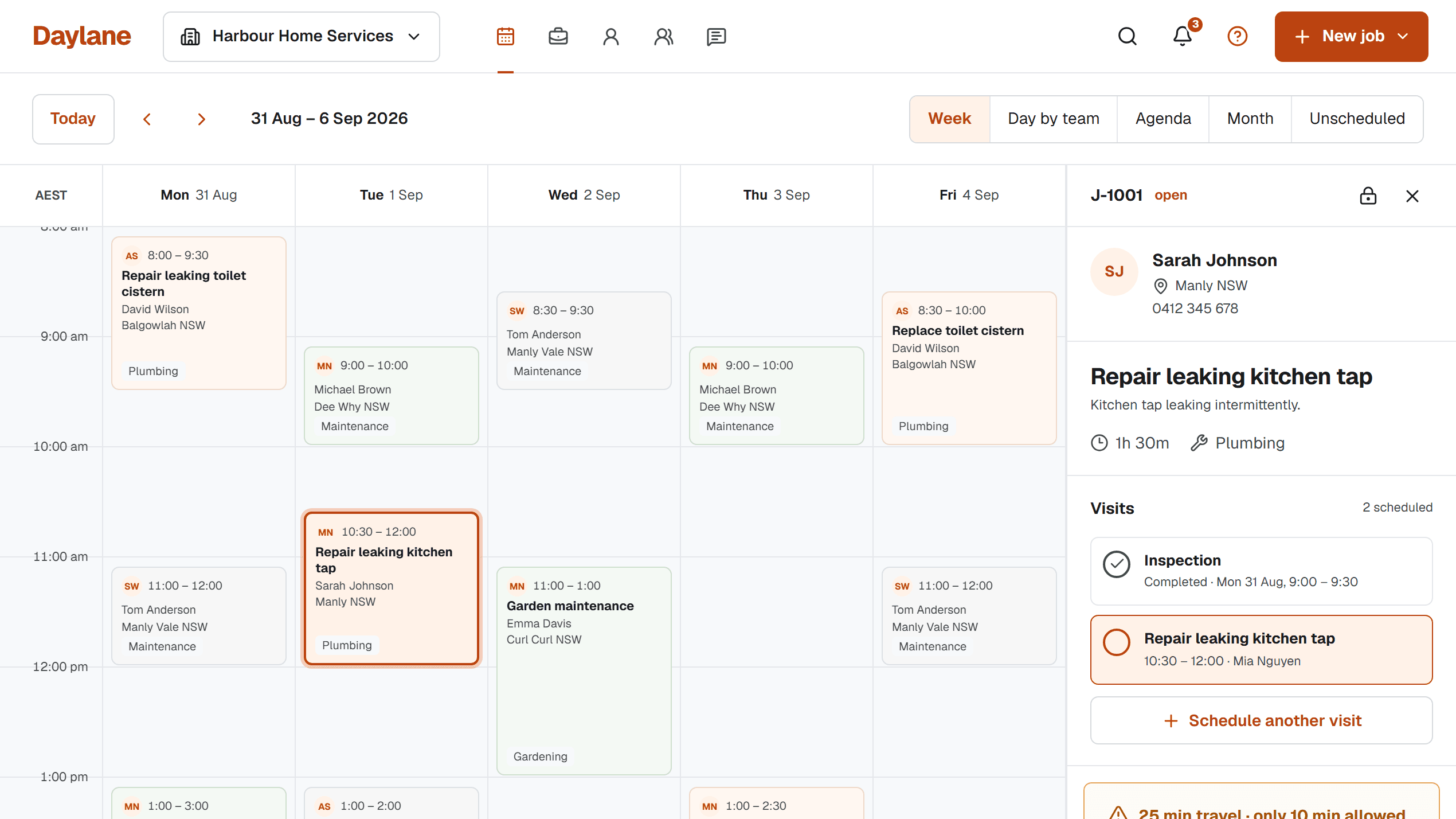
A weekly review closes the gap between what the calendar planned and what actually happened. Check unfinished work first, then next week's commitments, then one recurring source of disruption. Finish with a short list of actions that have owners and review dates. The purpose is to improve the next week, not produce a report nobody uses.
Reconcile this week's outcomes
Look at Visits that passed without a clear outcome. Identify work that was completed, moved, cancelled or left outstanding. A past date should not be the only clue that someone attended. Update factual notes while the context is fresh.
Then review open Jobs with no future Visit. Some will be waiting for a part or approval; others may simply have been forgotten. Give each a next action or record an explicit decision that no further work is proceeding.
Check next week's constraints
Review availability, customer access, materials and shared Visits before accepting more work. Check recurring commitments across the relevant cycle, especially when fortnightly work makes alternating weeks uneven.
- Any Visit with unresolved access or scope?
- Any return dependent on an unconfirmed part or approval?
- Any assigned person with conflicting work or missing travel time?
- Any promised customer update due before attendance?
- Any recurring exception that affects the next occurrence?
Investigate one repeated mismatch
Choose a concrete pattern, such as routine Visits taking longer than planned or a particular journey repeatedly causing lateness. Compare a few examples and identify which estimate or process needs to change. Avoid making a broad productivity claim from a single unusual day.
For example, if three comparable Visits each required an extra 15 minutes of loading, put that time into future plans. If the difference was caused by added customer scope, improve how additions are agreed instead of changing every service estimate.
Finish with a short action list
Write actions in a form someone can complete: 'confirm Thursday access with site manager on Monday' is better than 'sort next week'. Name the owner and review point. Keep the list short enough that it will be revisited during daily planning.
In Daylane, use the schedule, unscheduled work and Job history together. Review invoice hand-off readiness only for Jobs that are explicitly complete. This closes operational loose ends while keeping financial decisions in the appropriate invoicing or accounting process.
Sources and scope
An original operational guide from the Daylane team at Blu Mint Digital. Scenarios, durations and message wording are illustrative planning examples, not customer results or industry benchmarks. Product references were checked against the Daylane implementation on 5 September 2026. Adapt the workflow to your service, customer agreements and working conditions.
How we write and maintain our guides. Free templates and planning tools.