
Useful completion notes say what was done, what remains and what happens next. Write them so a person who did not attend can understand the outcome. A short factual record is more useful than 'all done' when a Job later needs a return Visit, a customer answer or an invoice summary.
Describe the work you actually completed
Use the agreed scope as the starting point, then record the work performed at this Visit. Do not copy the original request as though it proves every requested task was completed. Keep observations, actions and unverified assumptions distinguishable.
For several tasks, name the finished items and list anything outstanding separately. If a customer asked for an addition that was not performed, record that as a request or next action rather than burying it in the completion summary.
Use a four-part note
The following fictional example concerns a general maintenance Visit. It demonstrates record structure, not a required technical or compliance record.
- Completed: adjusted the two agreed cupboard doors and replaced the supplied handles.
- Remaining: third cupboard door requires a replacement hinge; not completed at this Visit.
- Customer update: explained the remaining item to the site contact and agreed to call with a return option.
- Next action: coordinator to confirm hinge availability on Tuesday; keep Job open.
Separate internal detail from the customer summary
A customer-facing summary should describe the useful outcome in plain language. Internal coordination notes may include dependencies, handover detail or instructions that do not belong in a message or invoice. Review what is being shared rather than forwarding the entire history.
In Daylane, the completed-Job invoice hand-off prepares selected details. It excludes internal notes, photos, Checklist results and Team Member details. Check the preview and write an appropriate work summary before continuing to the invoicing workflow.
Complete the Visit and assess the Job separately
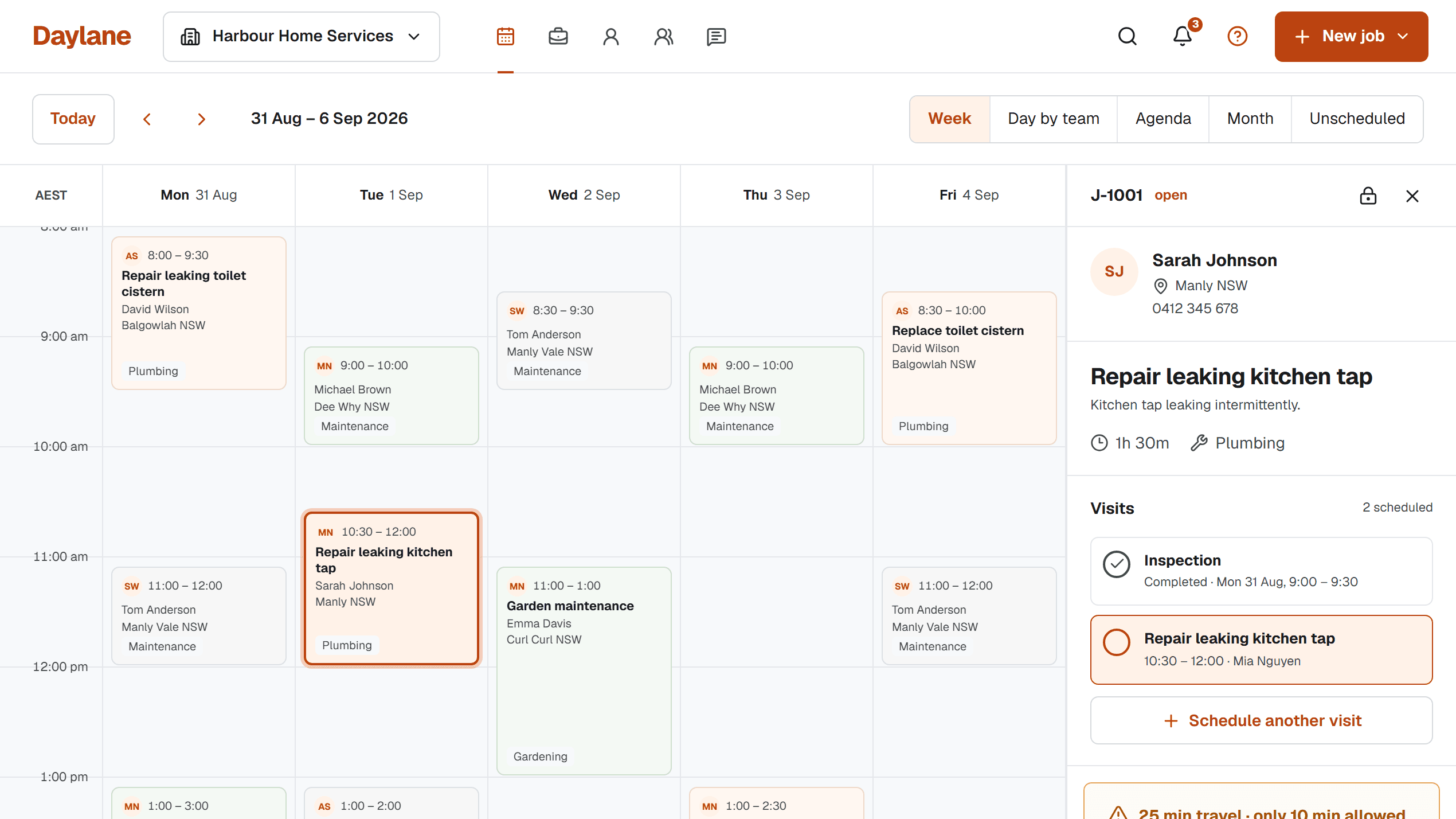
Ending an attendance answers 'what happened today?' Completing the Job answers 'is the agreed work finished?' When those answers differ, preserve both. Give unfinished work a visible next step, including who owns it and when it will be reviewed.
During a weekly review, sample a few notes for clarity. If someone must call the attending person to understand every outcome, improve the note prompts. More words are not necessarily the answer; consistent fields often make the handover easier to scan.
Sources and scope
An original operational guide from the Daylane team at Blu Mint Digital. Scenarios, durations and message wording are illustrative planning examples, not customer results or industry benchmarks. Product references were checked against the Daylane implementation on 5 September 2026. Adapt the workflow to your service, customer agreements and working conditions.
How we write and maintain our guides. Free templates and planning tools.