
To estimate daily capacity, subtract breaks, admin and a recovery buffer from your working day, then divide the remaining minutes by the time each Visit actually occupies. Include travel and setup. Round down, and check the proposed order against customer access times before promising a slot. An average gives you a starting limit; it does not produce a workable route on its own.
Count occupied time, not just time on the tools
A 60-minute service may occupy 90 minutes once you allow for parking, unloading, packing up and driving to the next address. If your diary contains only the service time, those extra minutes still happen: they simply come out of lunch or the next customer's arrival window.
Use one consistent convention for travel. You can attach the inbound trip to each Visit and reserve the final trip home separately. Avoid counting the same journey both at the end of one Visit and the beginning of the next.
Work through a sample day
Suppose the working day is 480 minutes. Reserve 30 for breaks, 30 for administration and 45 for recovery, leaving 375. If each Visit needs 60 minutes of service, 10 of setup and 20 of travel, each occupies 90 minutes. Four Visits use 360 minutes, leaving 15 unallocated minutes in addition to the recovery allowance.
Five Visits would need 450 minutes. That fifth booking does not fit just because its service time is only an hour. These are sample inputs, not recommended working hours or a promise about productivity.
Test the mix of work
Replace the average with the actual Visits before confirming the day. A first inspection may have uncertain duration; a routine service may be predictable. A locked commercial site might have a fixed access window that prevents the most convenient order.
For teams, calculate each person's day separately before combining capacity. Two people attending the same two-hour Visit consume four person-hours but deliver one Visit. Multiplying a solo estimate by headcount can overstate the number of customers you can serve.
Improve the estimate after a normal week
Record planned and actual occupied time for a few comparable Visits. Investigate repeated gaps: travel, waiting for access, missing materials or a service estimate that is too short. Adjust the relevant input rather than hiding every mismatch inside a larger buffer.
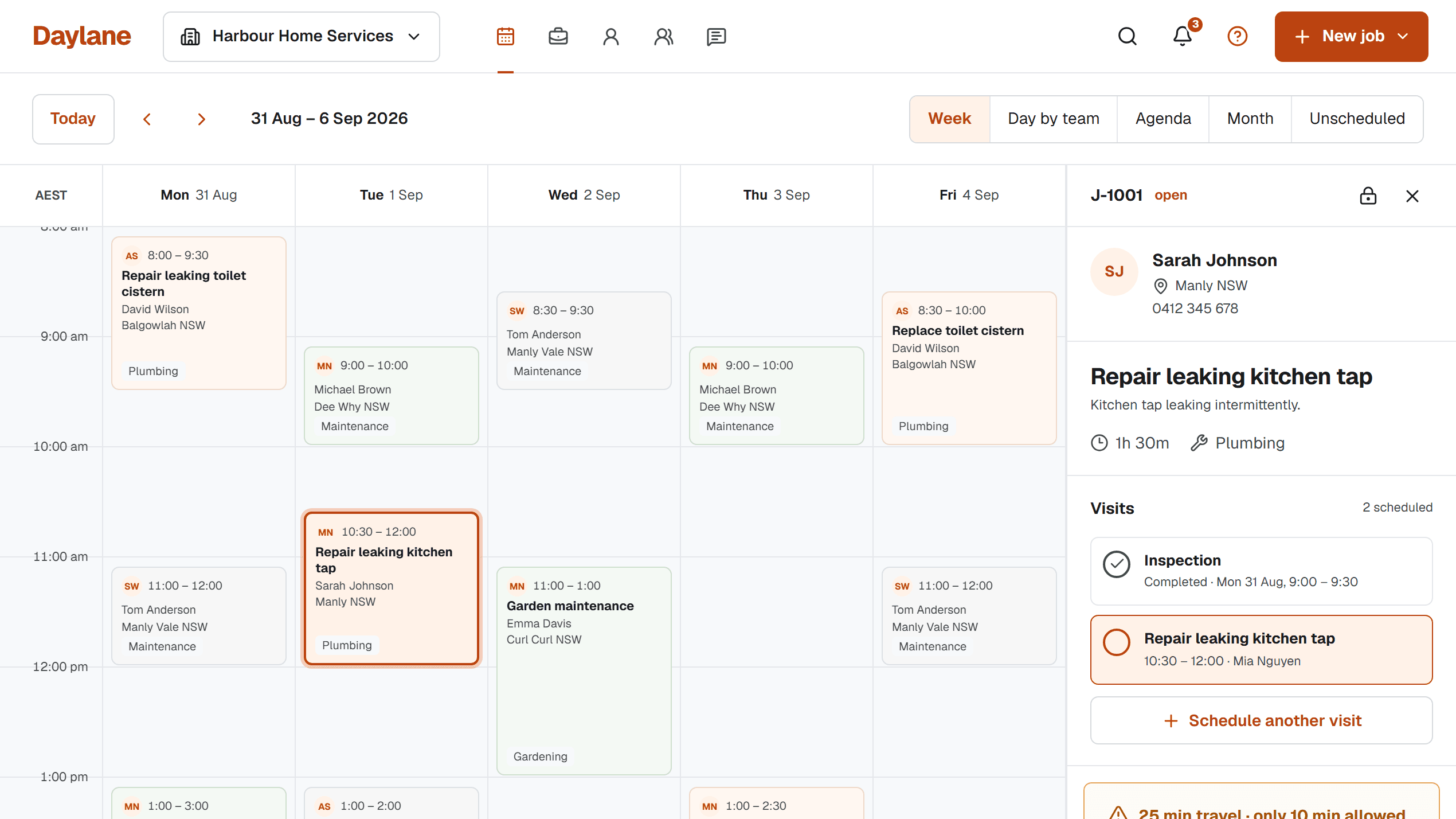
In Daylane, use the schedule for confirmed Visits and keep work without an agreed slot unscheduled. Recheck the day's total whenever you add an urgent Job or turn one Visit into a longer piece of work.
Sources and scope
An original operational guide from the Daylane team at Blu Mint Digital. Scenarios, durations and message wording are illustrative planning examples, not customer results or industry benchmarks. Product references were checked against the Daylane implementation on 5 September 2026. Adapt the workflow to your service, customer agreements and working conditions.
How we write and maintain our guides. Free templates and planning tools.