
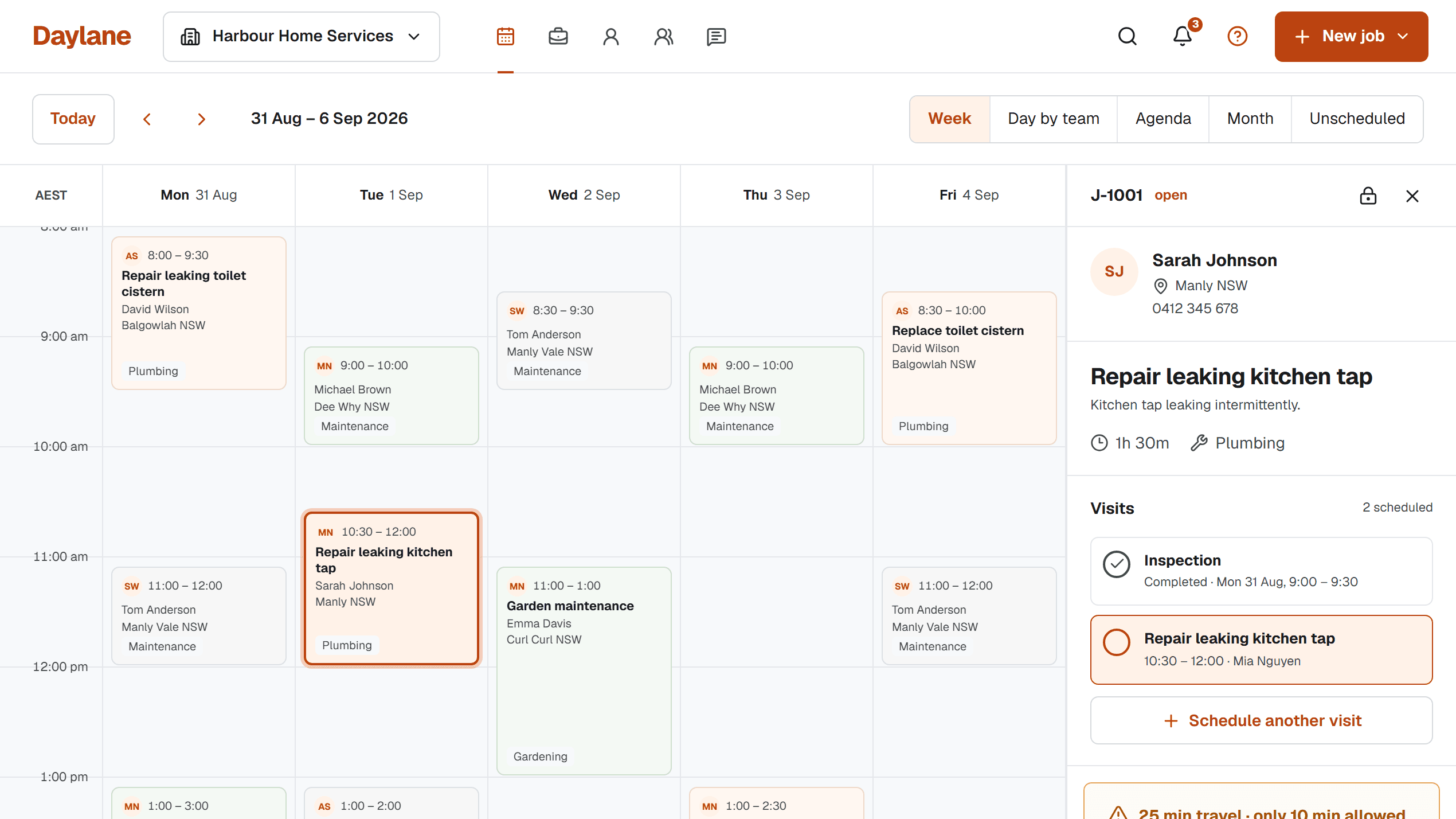
An urgent request needs a decision before it needs a calendar slot. Establish the service address, requested work, access and your ability to attend. Then identify which existing commitments would change. This guide covers scheduling only; emergencies involving danger need the appropriate emergency service and qualified response.
Collect enough information to decide
Ask what the customer needs attended to, where the work is, who can provide access and whether the requested work is within your scope. A postcode alone can hide a long trip or a site you cannot enter. Do not give an arrival promise while these basics remain unclear.
Record a contact number and a short description before ending the call. Keep diagnostic guesses separate from the customer's description so a colleague does not treat an unverified assumption as a confirmed fault.
Find the real opening
Look at travel, remaining service time and any recovery buffer. A visually empty half-hour is not usable if reaching the site takes most of it. If you need another team member or special equipment, verify both before offering the time.
For example, an urgent Visit may require 25 minutes of travel, 60 minutes on site and 15 minutes of pack-up. It occupies 100 minutes. A 45-minute buffer will not absorb it; identify the exact booking that would move and the next feasible option for that customer.
Agree the changes before dispatching
Contact affected customers with a concrete revised option. Keep the original commitment visible until the change is agreed. A sent message is not the same as acceptance, especially when access depends on someone leaving work to meet you.
- Confirm the urgent customer's address, contact and proposed arrival window.
- Check the assigned person's availability and equipment.
- Record which existing Visits must change and who will contact each customer.
- Update the calendar and confirm accepted changes before the revised dispatch.
Review the interruption
After the callout, record what was completed and whether a return is needed. Keep unfinished work under the same Job with a clear next action. Before closing the day, check every displaced booking has either a new confirmed slot or an owner responsible for arranging one.
If urgent work is a regular part of your business, review how much time it actually occupies over several weeks. Use that evidence to reserve capacity rather than treating every callout as an unexpected exception.
Sources and scope
An original operational guide from the Daylane team at Blu Mint Digital. Scenarios, durations and message wording are illustrative planning examples, not customer results or industry benchmarks. Product references were checked against the Daylane implementation on 5 September 2026. Adapt the workflow to your service, customer agreements and working conditions.
How we write and maintain our guides. Free templates and planning tools.