
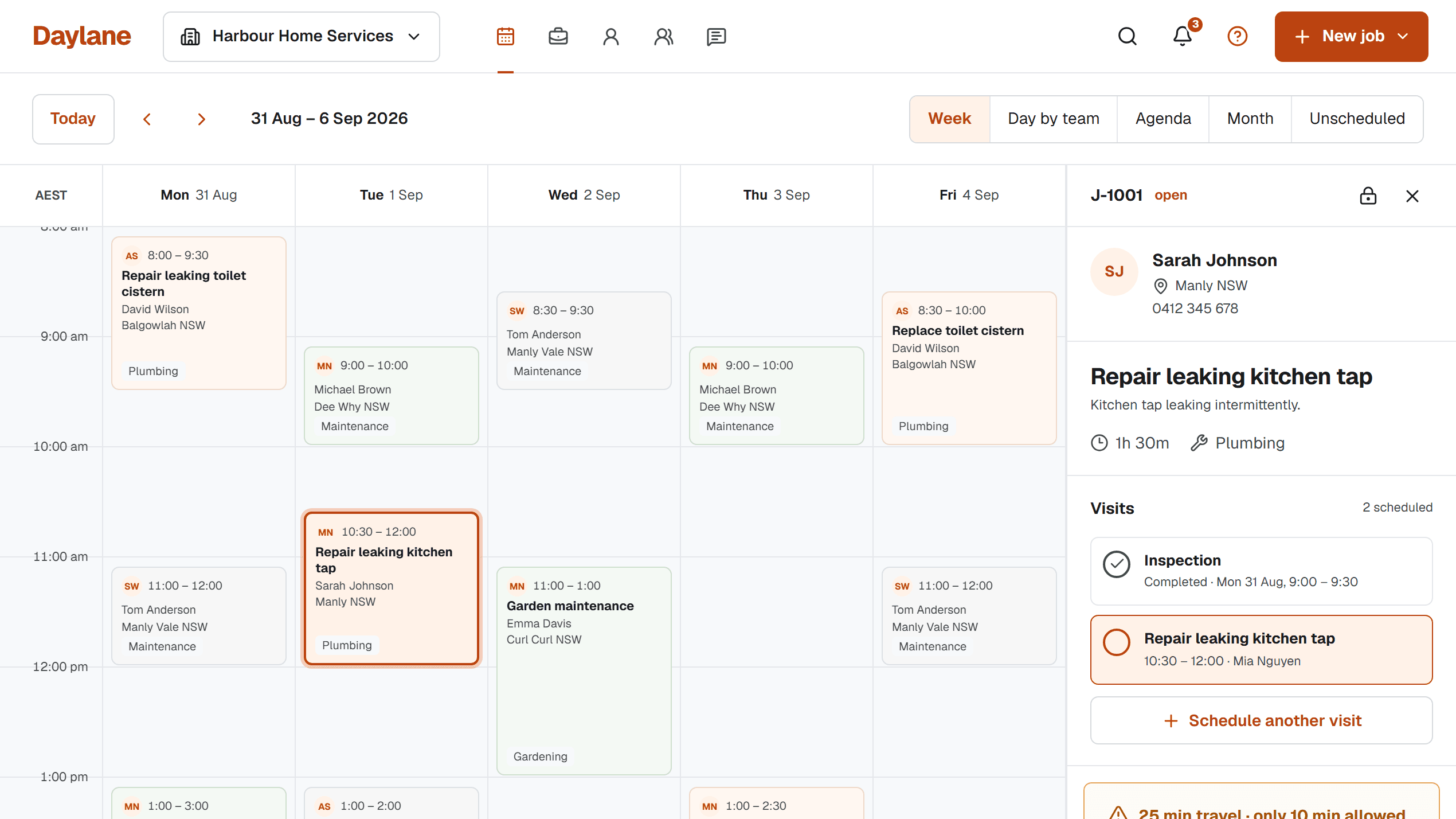
Travel time is part of the working day even when it is not the service itself. Ignoring it produces a calendar that looks efficient and behaves badly. A practical buffer accounts for the journey, parking, access and small pieces of administration while still keeping useful capacity available.
Build the buffer from real components
Think beyond the map estimate. A field Visit may include packing up, speaking with the Customer, reaching the vehicle, traffic, parking, signing in and finding the work area. Use the components that recur in your own Jobs rather than copying a standard fifteen-minute gap.
The buffer can differ by area, time of day and Job type. Work inside one apartment complex may need little driving but significant access time. A suburban route may have easy access and longer distance. The calendar should reflect the actual constraint.
Distinguish travel from uncertainty
A travel buffer protects the journey. A duration estimate protects the work. If a repair is unpredictable, increasing only the travel gap hides the real issue and makes later reporting less useful. Schedule an inspection, use a wider Arrival Window or give the Job a longer duration.
Separating these values also improves learning. If Jobs routinely finish on time but the next Visit starts late, travel assumptions may be wrong. If the delay begins on site, revisit the Job estimate or checklist.
Cluster carefully, not blindly
Grouping nearby work can reduce travel, but Location should not overrule urgency, skill, parts or Customer availability. Use geography as one input. A neat route is not successful if it places the wrong person at the wrong Job or leaves urgent work waiting.
When offering a Customer a time, give an exact start only when the schedule supports it. An Arrival Window can be more honest for field work, provided the Business uses it consistently and updates the Customer when circumstances materially change.
Review the exceptions each week
Track the moments when someone overrides a travel warning or arrives outside the expected window. You do not need complex analytics; a brief weekly review can show repeating problem areas, unrealistic start times or Job types that need different defaults.
The goal is not to eliminate every gap. A small amount of unallocated time protects Customer communication, safety and quality. A schedule with no recovery margin transfers every earlier delay to every later Customer.
Sources and scope
This practical guide was checked against the primary sources below on 1 September 2026. It is general information, not legal, tax, safety or accounting advice for your circumstances.
How we write and maintain our guides. Free templates and planning tools.