
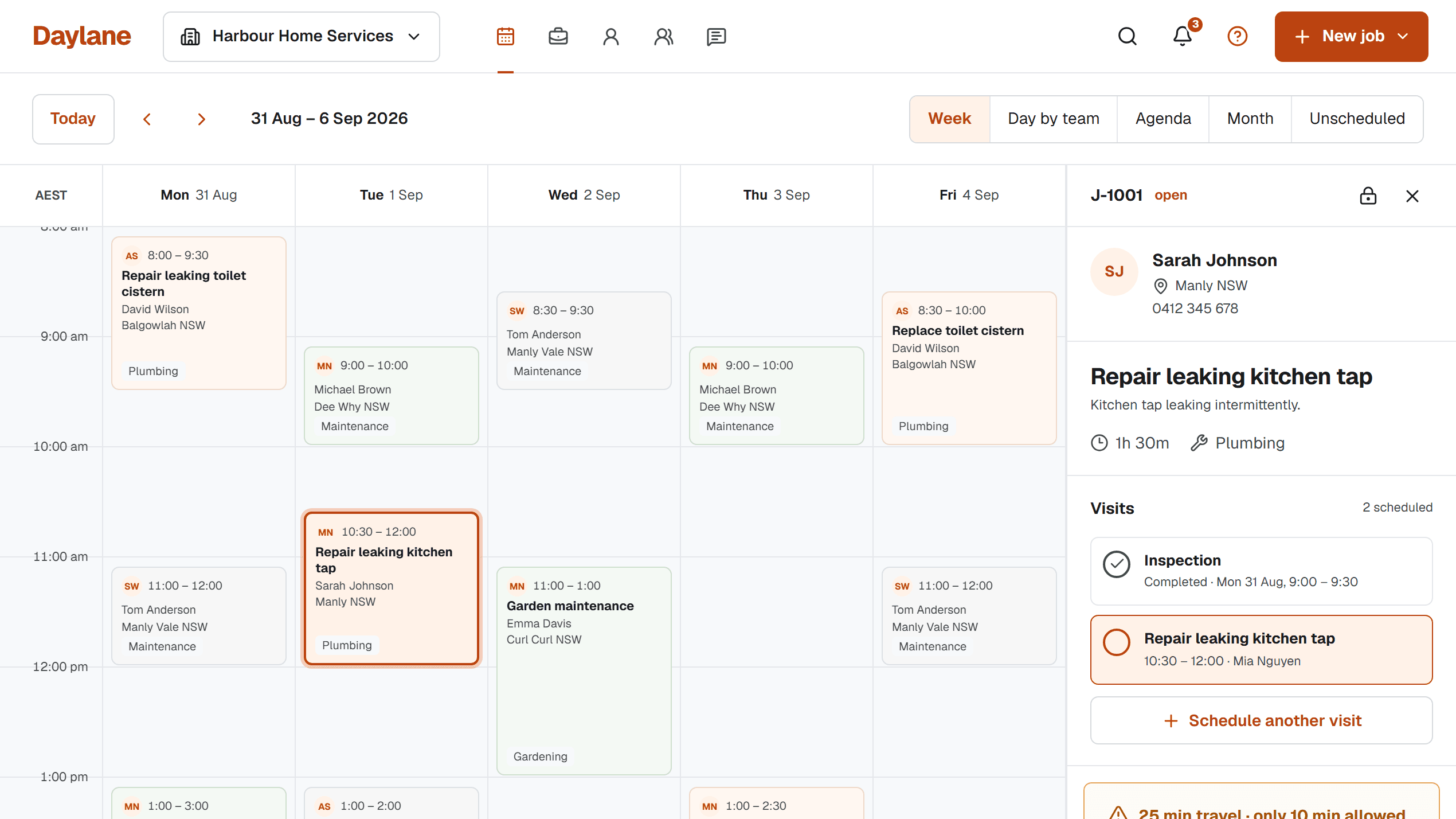
Describe the additional work and decide whether it belongs to this occurrence's agreed scope or needs its own Job. Reserve the extra time explicitly. A one-off request should not quietly become part of every future service, and an unchanged duration should not hide a larger workload.
Choose the scope boundary
A small additional task may fit one agreed attendance. A separately approved project may need its own Job even at the same property. Use the approval and completion decision to choose, then make the resulting scope clear to the customer and attending person.
| Request | Possible record choice | Scheduling check |
|---|---|---|
| Clean one extra room during this clean | Update this occurrence's agreed scope | Add the estimated room time |
| Repair a damaged cupboard during a regular maintenance month | Separate Job with its own approval | Reserve assessment and possible return time |
Recalculate the occupied time
Suppose the normal Visit is 60 minutes and the extra task needs another 30. Check a 90-minute service reservation plus the relevant travel and setup. If the next customer prevents that extension, offer a separate slot or keep the original scope.
Do not treat recurring work as flexible merely because it repeats. Confirm the customer's access window and the next Visit's commitment before shifting either one.
Keep the extra out of the default pattern
Daylane creates separate Jobs for recurring occurrences. Review the specific Job and Visit you change, and check the next occurrence still has the standard scope. Avoid editing the future pattern merely to accommodate one extra task.
An edited occurrence is protected from later future-pattern updates. If you subsequently revise the overall schedule, review that exception individually. Record what was completed so the next attending person does not repeat the extra work unnecessarily.
Sources and scope
An original operational guide from the Daylane team at Blu Mint Digital. Scenarios, durations and message wording are illustrative planning examples, not customer results or industry benchmarks. Product references were checked against the Daylane implementation on 5 September 2026. Adapt the workflow to your service, customer agreements and working conditions.
How we write and maintain our guides. Free templates and planning tools.