
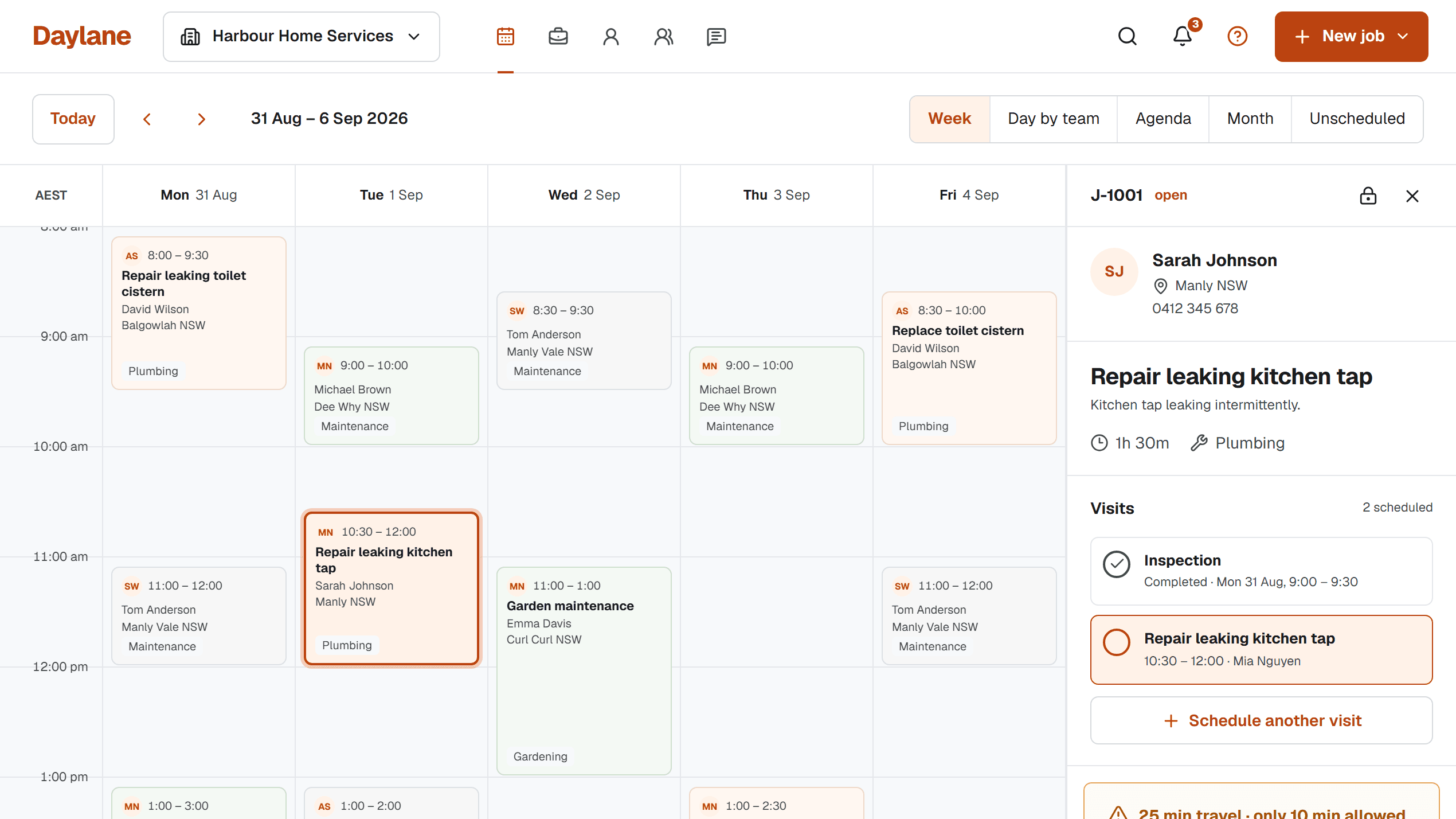
Give each Job a short title that identifies the agreed task and the object or area involved. Use the Customer and Location records for identity and destination, then reserve notes for the full scope. A useful title lets you distinguish two Jobs at a glance without turning the calendar into a paragraph.
Start with the action and its target
Choose a concrete verb such as inspect, clean, service or replace. Add the relevant room, item or work area. If assessment is all that has been agreed, use 'inspect' rather than a title that promises a completed repair. The title should accurately describe the booking before anyone reads the longer instructions.
| Vague title | More useful title | Why it helps |
|---|---|---|
| Cleaning | Clean vacant unit before handover | Identifies the purpose of this clean |
| Garden | Trim courtyard hedge | Names the work area and task |
| Maintenance | Inspect meeting-room door closer | Distinguishes inspection from replacement |
| Appliance | Assess washing-machine drainage issue | Records an assessment without assuming the cause |
| Windows | Clean ground-floor shopfront windows | Makes the agreed area visible |
| Return | Fit approved replacement cupboard hinge | Explains the return work |
Keep changeable attendance details in the Visit
A title such as 'Tuesday 9 am with Sam' becomes misleading after a reschedule. Record attendance timing and assignment with the Visit. Keep entrance arrangements, phone numbers and lengthy conditions in appropriate instruction fields, where someone can read the complete detail.
If the same Job needs an assessment and a later return, the Job title should still make sense for the overall agreed work. Describe each attendance's purpose in its instructions rather than repeatedly renaming the Job to match the latest date.
Write titles that customers can also read
Daylane displays the Job title on its shared Visit page. Use plain, professional wording and avoid private shorthand or internal customer commentary. Read the title with the customer instructions to check that both describe the same scope.
Review a real day of titles together
Look at tomorrow's Jobs and identify pairs that are hard to distinguish. Change only the wording needed to make the difference clear. Agree a simple team convention, such as action plus item or area, and use it consistently. A longer title is worthwhile only when its extra detail helps someone choose or understand the correct Job.
Sources and scope
An original operational guide from the Daylane team at Blu Mint Digital. Scenarios, durations and message wording are illustrative planning examples, not customer results or industry benchmarks. Product references were checked against the Daylane implementation on 5 September 2026. Adapt the workflow to your service, customer agreements and working conditions.
How we write and maintain our guides. Free templates and planning tools.