
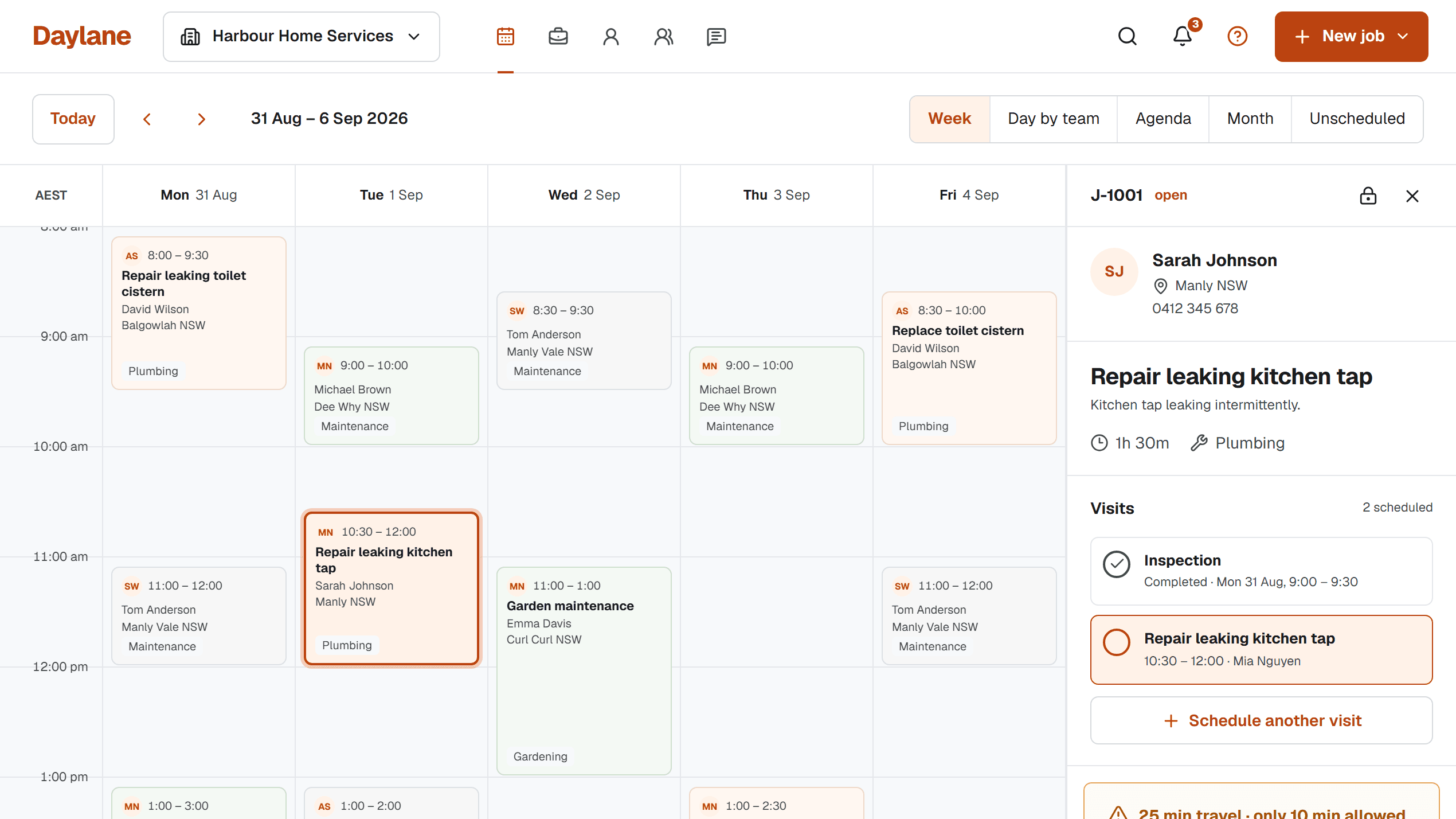
Put a detail with the record it describes: the customer relationship, the service property, the agreed work or one attendance. Then check who can actually see that field. A note can be correctly stored and still fail as a handover if the person attending never sees it.
Choose the detail's scope first
A standing entrance arrangement belongs with the Location; a temporary arrangement for Friday belongs with that Visit. A restriction on the agreed work belongs with the Job. Avoid copying a temporary instruction into every record, where it can look current months later.
| Detail | Field | Check before relying on it |
|---|---|---|
| Office handles scheduling enquiries | Customer internal notes | Customer record is available to the scheduler |
| Use reception entrance | Location access notes | Relevant information is included in the attendance brief |
| Inspect only; additional work needs approval | Job internal notes | Assigned person's Visit has the necessary scope instruction |
| Please clear the work area before arrival | Job customer instructions | Wording is appropriate for the shared Visit page |
| For this Visit, meet the temporary contact outside | Visit internal instructions | Assigned person sees the current Visit instructions |
Treat customer instructions as shareable content
Daylane's public Visit page displays the Job title, attendance details, service address and Job customer instructions. It does not display Customer internal notes, Location access notes, Job internal notes or Visit internal instructions. Keep private commentary and restricted access information out of the customer-instructions field.
Review the public page before sending its link. A field called customer instructions is a place for wording the customer can read, even when that same wording is useful to your team.
Check the private Visit view too
The private Visit detail view includes Job customer instructions and Visit internal instructions. Location access notes are not included in that view. If a Location detail is essential to attendance, confirm it is current and put the necessary instruction into the Visit briefing. Do not assume every property note follows the team automatically.
Remove ambiguity when an instruction changes
Replace obsolete operational wording where it would mislead the next reader. When context matters, add a dated explanation such as 'Reception entrance confirmed for this Visit on 5 September; previous rear-entry arrangement no longer applies.' Review any copied briefs as well. This is a manual note convention, not an automatic contact-change audit feature.
Sources and scope
An original operational guide from the Daylane team at Blu Mint Digital. Scenarios, durations and message wording are illustrative planning examples, not customer results or industry benchmarks. Product references were checked against the Daylane implementation on 5 September 2026. Adapt the workflow to your service, customer agreements and working conditions.
How we write and maintain our guides. Free templates and planning tools.