
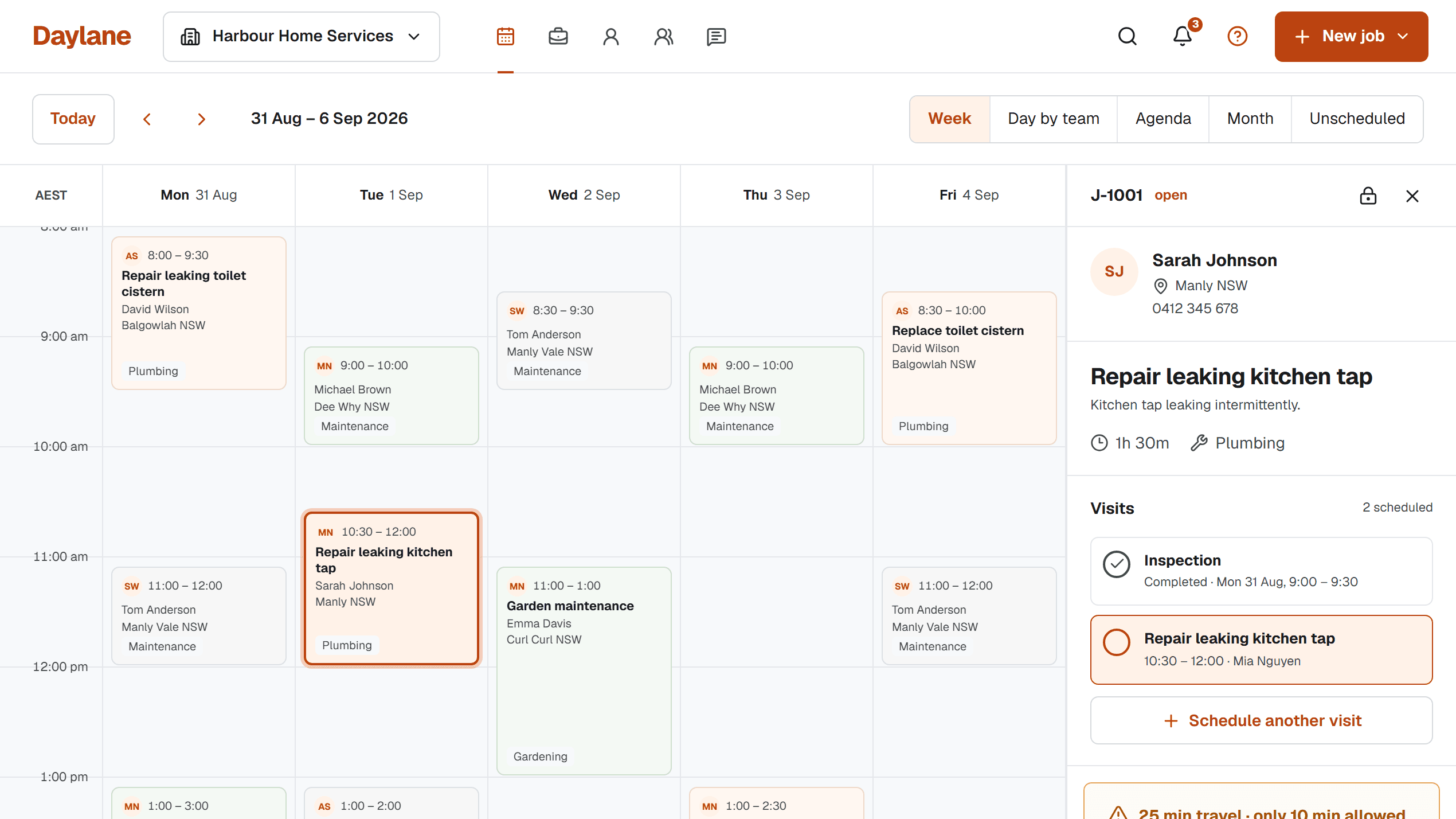
Use separate Jobs when work at the same property has independent scopes and completion decisions. Keep those Jobs linked to the same service Location when the Customer relationship is also the same. Use another Visit on an existing Job when you are continuing that Job's agreed work.
Separate the destination from the work
In this fictional example, one business arranges both an office clean and a door inspection at its north office. The destination is shared, but finishing the clean does not finish the inspection. Separate Jobs make each outcome and follow-up understandable.
| Customer | Location | Job | Visit purpose |
|---|---|---|---|
| Example Property Services | North office | Clean office before handover | Complete the agreed clean |
| Example Property Services | North office | Inspect meeting-room door | Assess the reported problem |
| Same Customer | Same Location | Continue the door Job if agreed scope covers the return | Attend again with the required part |
Use the completion decision as a test
Ask whether one piece of work could be complete while the other remains open. If yes, separate Jobs may make sense. Also check whether they have different approvals, instructions or dependencies. A shared address alone is not a reason to combine their records.
Conversely, several small tasks can belong to one agreed maintenance Job when they share an approval and a clear combined outcome. The goal is an understandable scope, not the greatest possible number of records.
Distinguish a return from a new request
If the door inspection leads to a return that continues the agreed door work, another Visit can preserve that chain on the same Job. If the customer separately requests an unrelated cupboard repair, create a new Job with its own scope. Record why you made the distinction so a later reviewer can follow the decision.
Do not reuse a completed Job merely because its title or address looks convenient. A new request should not obscure the outcome of earlier work.
Coordinate the day without merging the records
Two Jobs at the same Location may be scheduled near each other when access, duration and assignment allow it. Check each Visit's time and instructions individually. Confirming one Visit does not establish the other, and completing one Job does not close the other.
If different customers commission work at the same street address, check the customer relationship before reusing any record. Shared premises do not automatically imply shared instructions, approval or customer history.
Sources and scope
An original operational guide from the Daylane team at Blu Mint Digital. Scenarios, durations and message wording are illustrative planning examples, not customer results or industry benchmarks. Product references were checked against the Daylane implementation on 5 September 2026. Adapt the workflow to your service, customer agreements and working conditions.
How we write and maintain our guides. Free templates and planning tools.