
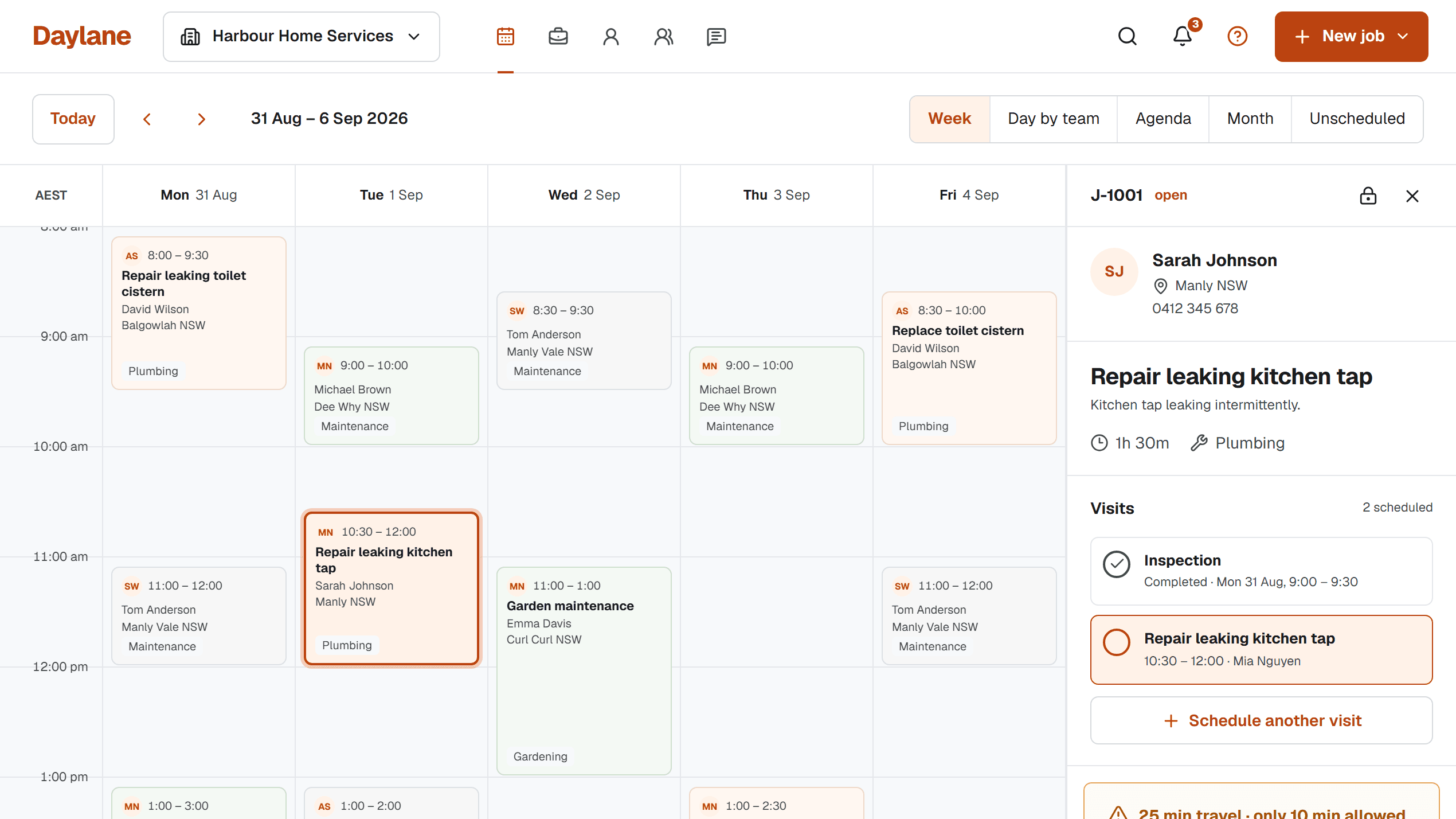
Give an alternating round a clear Week A anchor date, then plan Week A and Week B as separate working weeks. Weekly customers appear in both; fortnightly customers belong to the agreed alternating week. Check actual dates before setting recurrence so the labels do not drift from the calendar.
Anchor the labels to real dates
The fictional example uses Monday 7 September 2026 as the start of Week A and Monday 14 September as Week B. The pattern returns to Week A on 21 September. These are planning examples, not a holiday or closure calendar.
| Work | Week A | Week B |
|---|---|---|
| Weekly office clean | Monday | Monday |
| Fortnightly courtyard service | Wednesday | Not in this week |
| Alternate fortnightly unit clean | Not in this week | Wednesday |
| Flexible one-off capacity | Review after fixed work | Review independently |
Budget each week on its own
Do not average a busy Week A and a quiet Week B and assume both have the same daily capacity. Add the actual durations, setup and journeys for each sequence. Review shared-team time per person where relevant.
A customer holiday or a postponed occurrence does not automatically shift the whole alternating pattern. Confirm what happens to the affected service and the next regular date.
Use the planner as a checked snapshot
The free worksheet includes an anchor-date field, both five-day working grids and space for travel, exceptions and confirmations. Adapt the days to your business. Printing the sheet does not create or update Daylane bookings.
When entering Pro+ recurrence, use the intended weekly interval and weekday, then compare generated dates with the planner. Resolve existing manually booked work so two records do not own the same occurrence.
Sources and scope
An original operational guide from the Daylane team at Blu Mint Digital. Scenarios, durations and message wording are illustrative planning examples, not customer results or industry benchmarks. Product references were checked against the Daylane implementation on 5 September 2026. Adapt the workflow to your service, customer agreements and working conditions.
How we write and maintain our guides. Free templates and planning tools.