
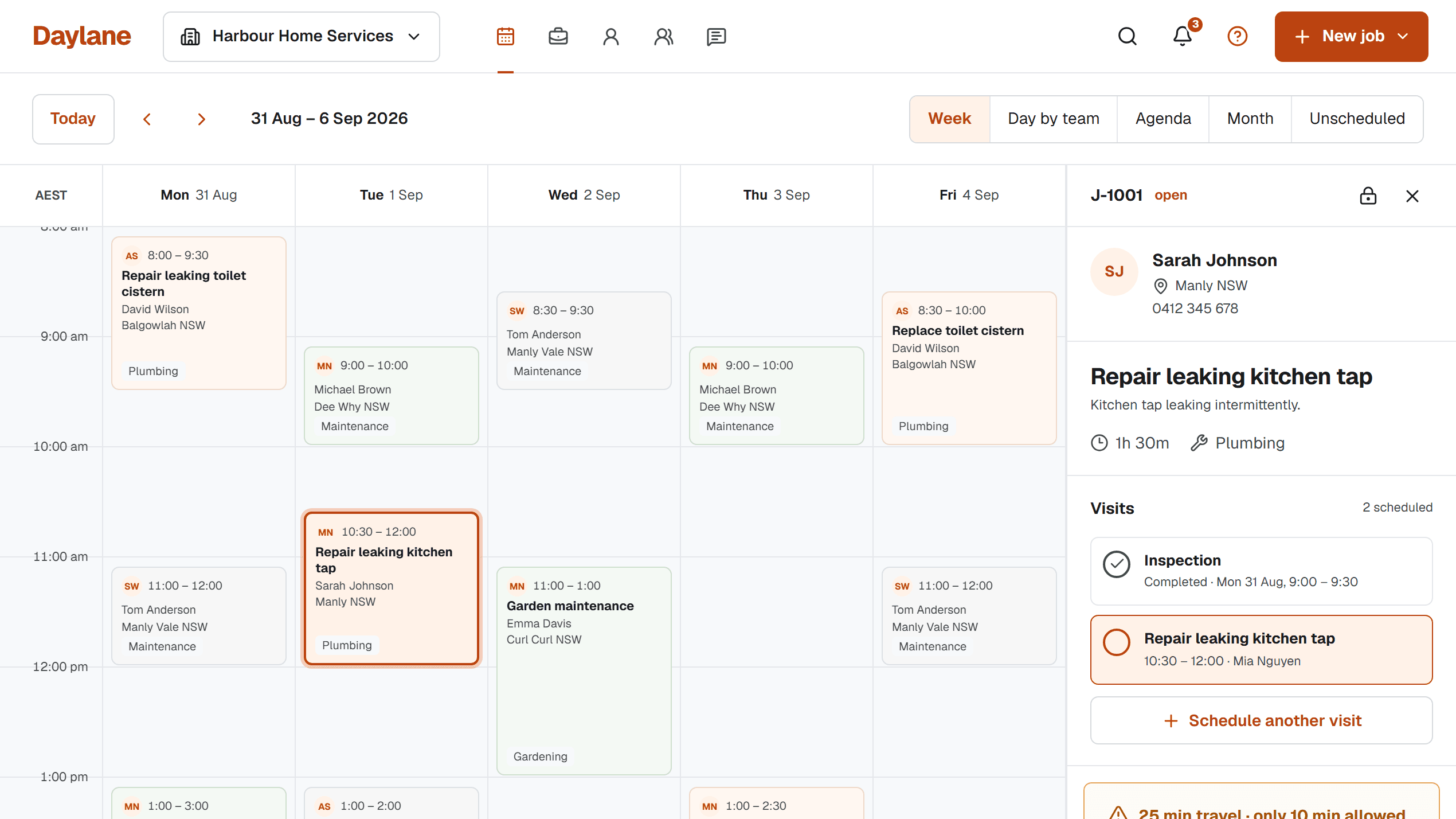
Start a cleaning round with each property's service length and access window, then group Visits into days you can actually deliver. Weekly and fortnightly customers need different planning horizons. Review at least two consecutive weeks before promising a regular time, so a quiet week does not disguise an overloaded one.
Make the property the unit of planning
A customer's name is not enough to schedule a clean. Keep the service address, agreed scope, estimated duration and the person arranging access with the Job. If one customer has a home and an office, create distinct Location records so instructions do not get mixed up.
Keep operational access notes specific, such as 'customer meets cleaner at reception'. Store sensitive access details using an appropriate secure process. They should not appear in public downloads, broadly shared calendar titles or sample records.
Lay out both weeks of a fortnight
In an illustrative round, three weekly customers occupy Monday in both weeks. Two fortnightly customers also want Monday but alternate weeks. Check the duration of each pair separately: alternating does not mean the two Mondays have equal capacity.
Write recurring commitments first, then add one-off work around the remaining usable time. A larger first clean may need more time than a maintenance Visit; do not use the recurring duration until you have checked the initial scope.
Keep travel and service scope visible
Nearby properties can still have incompatible access windows. A customer who needs you to arrive after school drop-off may rule out an otherwise convenient first stop. Order the day using both geography and agreed timing.
- Check access and parking before offering a regular window.
- Include loading and travel between properties.
- Record separately any agreed extras for this occurrence.
- Keep enough room for the actual service rather than promising a fixed number of houses.
Change one occurrence deliberately
When a customer skips a week or requests a different day, confirm whether the change affects only that Visit or the ongoing pattern. Review the following occurrence to avoid accidentally skipping another service.
Daylane keeps Visits connected to Jobs and Locations; Pro+ adds recurring Jobs. Test a normal clean, an extra service and a changed occurrence during the trial. You still decide the route and confirm customer access.
Sources and scope
An original operational guide from the Daylane team at Blu Mint Digital. Scenarios, durations and message wording are illustrative planning examples, not customer results or industry benchmarks. Product references were checked against the Daylane implementation on 5 September 2026. Adapt the workflow to your service, customer agreements and working conditions.
How we write and maintain our guides. Free templates and planning tools.