
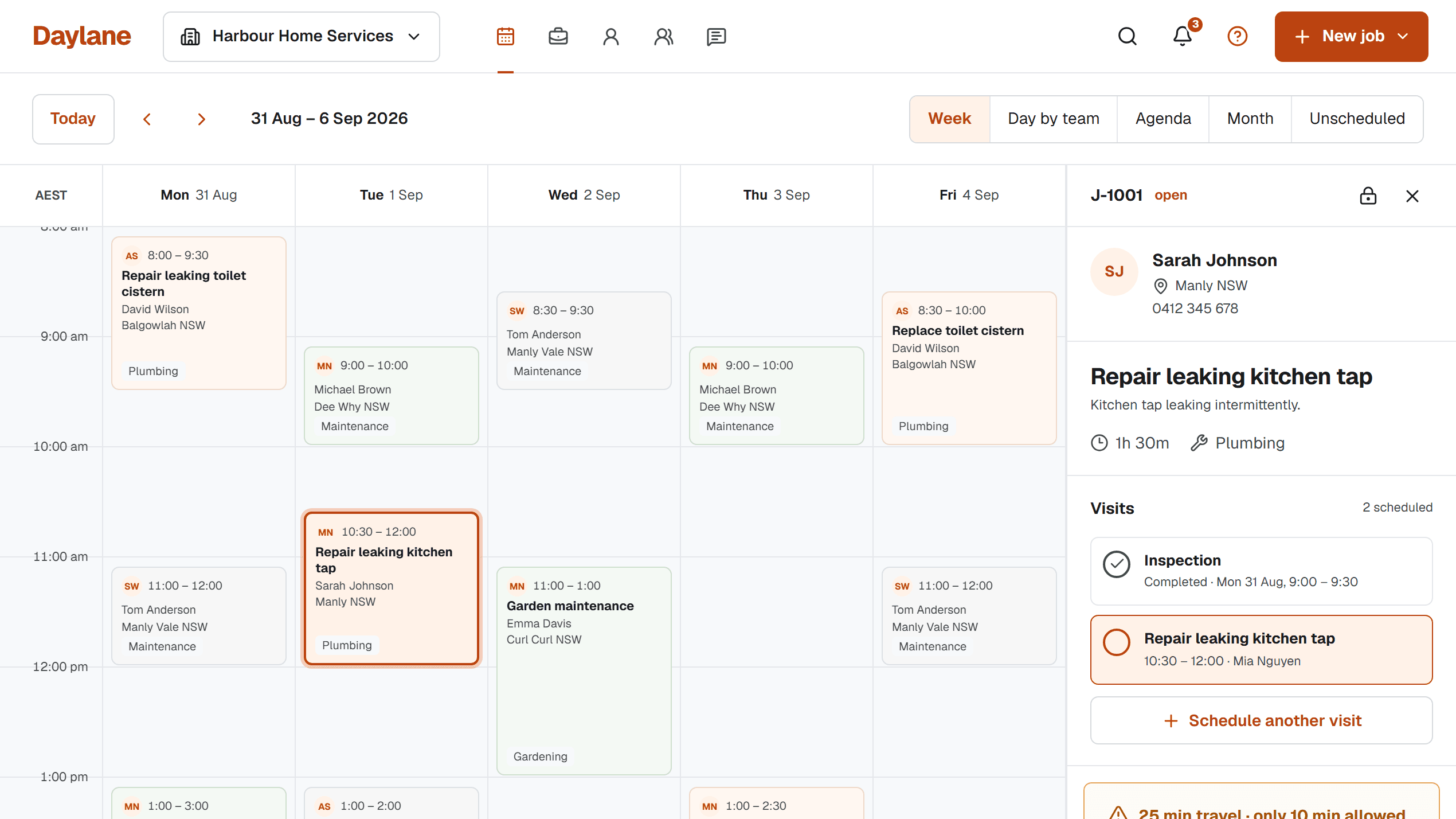
Before creating a recurrence, list the future work already booked for that Customer and service Location. Choose the first date the new pattern should own. Then compare the generated Jobs with the list. A recurrence system can protect against generating the same occurrence twice without identifying two independently created series as the same service.
Choose one owner for each service date
This fictional cleaning schedule already contains two manually booked Visits. The intended new recurrence begins after them. Starting the series on the first existing date would require resolving overlap rather than assuming the software recognises that the manually entered work is equivalent.
| Service date | Existing record | Intended owner |
|---|---|---|
| 7 September | Manual Job J-0101 | Keep existing Job |
| 21 September | Manual Job J-0102 | Keep existing Job |
| 5 October | None | New recurrence |
| 19 October | None | New recurrence |
Understand the duplicate boundary
Daylane prevents repeated materialisation of the same recurrence's occurrence date. Its source Job also cannot simply receive another recurrence through the normal create action. These protections do not compare the meaning of every manually created Job or another source Job's separate recurrence.
Check the same Customer, Location, task and date together. Similar titles alone are insufficient: two different services at one property may be intentional. Keep independent Jobs when their scope and completion decisions differ.
Review the result before sending confirmations
Inspect the first generated dates, primary assignee and duration. Reconcile any pre-existing Visit near the start date. If generation reports pending work, inspect the recurrence result and subsequent schedule before attempting another series.
When you find a duplicate, identify which record carries the current instructions and customer commitment, then resolve the other deliberately. Do not bulk-delete records merely because their names resemble each other. Preserve the actual service history and communicate only the agreed booking.
Sources and scope
An original operational guide from the Daylane team at Blu Mint Digital. Scenarios, durations and message wording are illustrative planning examples, not customer results or industry benchmarks. Product references were checked against the Daylane implementation on 5 September 2026. Adapt the workflow to your service, customer agreements and working conditions.
How we write and maintain our guides. Free templates and planning tools.