
Agree whether the missed service is no longer needed, still needs doing later, or signals a change to the ongoing pattern. Those are different decisions. Record the outcome for this occurrence and confirm the next expected date so the customer and scheduler are working from the same plan.
Name the outcome before changing the calendar
Ask a direct question: 'Do you want to miss this service and keep the next regular date, or arrange a replacement attendance?' Avoid treating 'not this week' as a complete instruction. The customer may still need the work before the next regular occurrence.
| Agreement | This occurrence | Future pattern |
|---|---|---|
| No service needed this time | Record the agreed cancellation | Keep the next regular date |
| Work still needed on Friday | Reschedule this Visit if feasible | Check the gap to the next occurrence |
| Monthly from now on | Agree the transition date | Review the recurrence pattern |
Check the gap created by postponement
Moving a fortnightly service close to the following occurrence may create two attendances only a few days apart. Ask whether both remain useful before leaving them confirmed. This is a scope and customer-agreement decision, not a mathematical reason to shift the whole series.
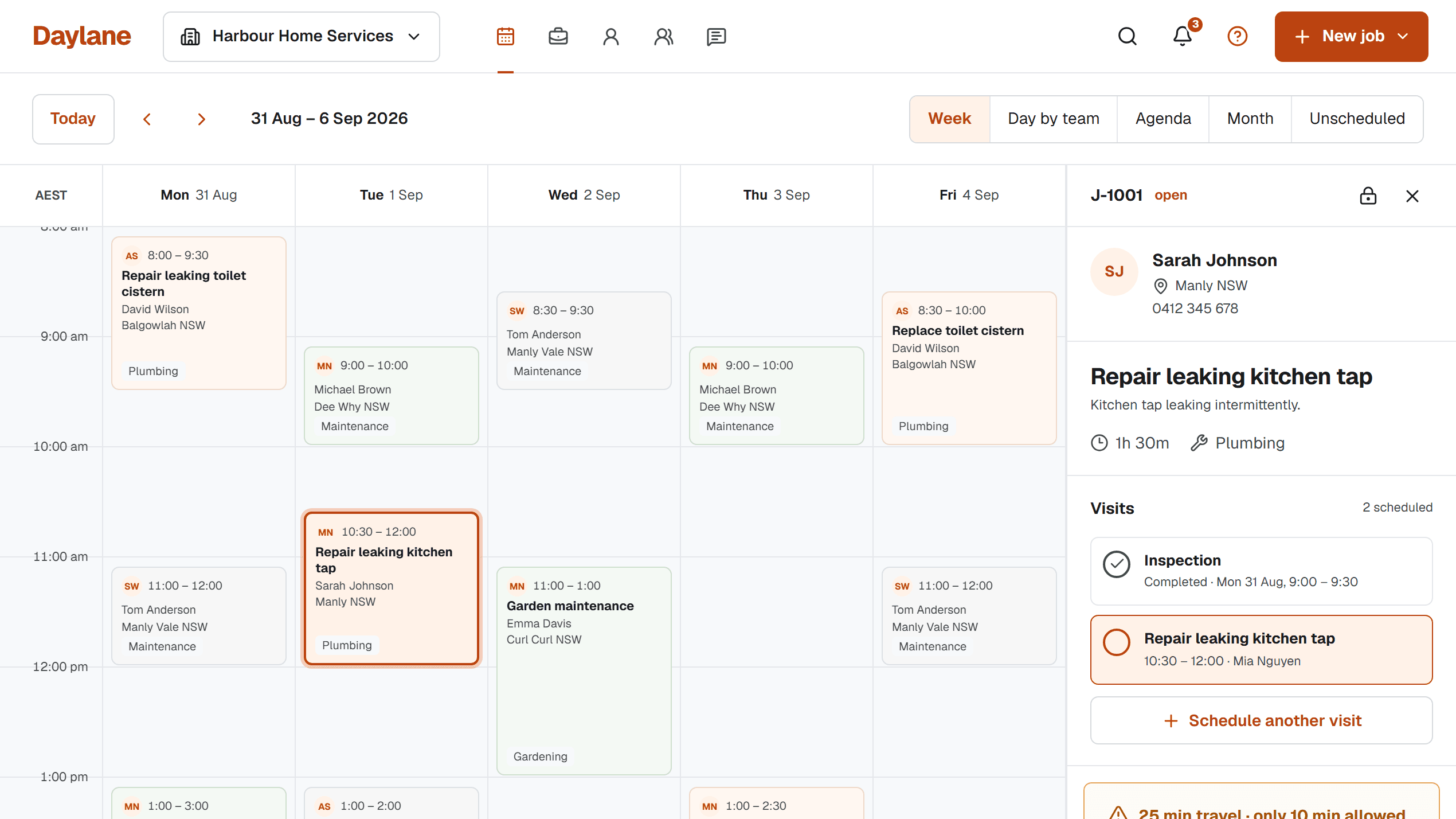
Daylane creates separate Jobs for recurring occurrences. Moving or completing one does not shift the rest. Review the next scheduled Job explicitly after changing the affected Visit.
Close the communication loop
Write the replacement or skipped date, the next regular date and who agreed to the change. For example: 'This week's clean is not required. The next regular Visit remains 21 September.' Check the actual dates before sending that wording.
If the customer wants an indefinite stop, review future generation and already-created Jobs separately. Pausing a recurrence stops new generation but leaves existing scheduled work in place.
Sources and scope
An original operational guide from the Daylane team at Blu Mint Digital. Scenarios, durations and message wording are illustrative planning examples, not customer results or industry benchmarks. Product references were checked against the Daylane implementation on 5 September 2026. Adapt the workflow to your service, customer agreements and working conditions.
How we write and maintain our guides. Free templates and planning tools.