
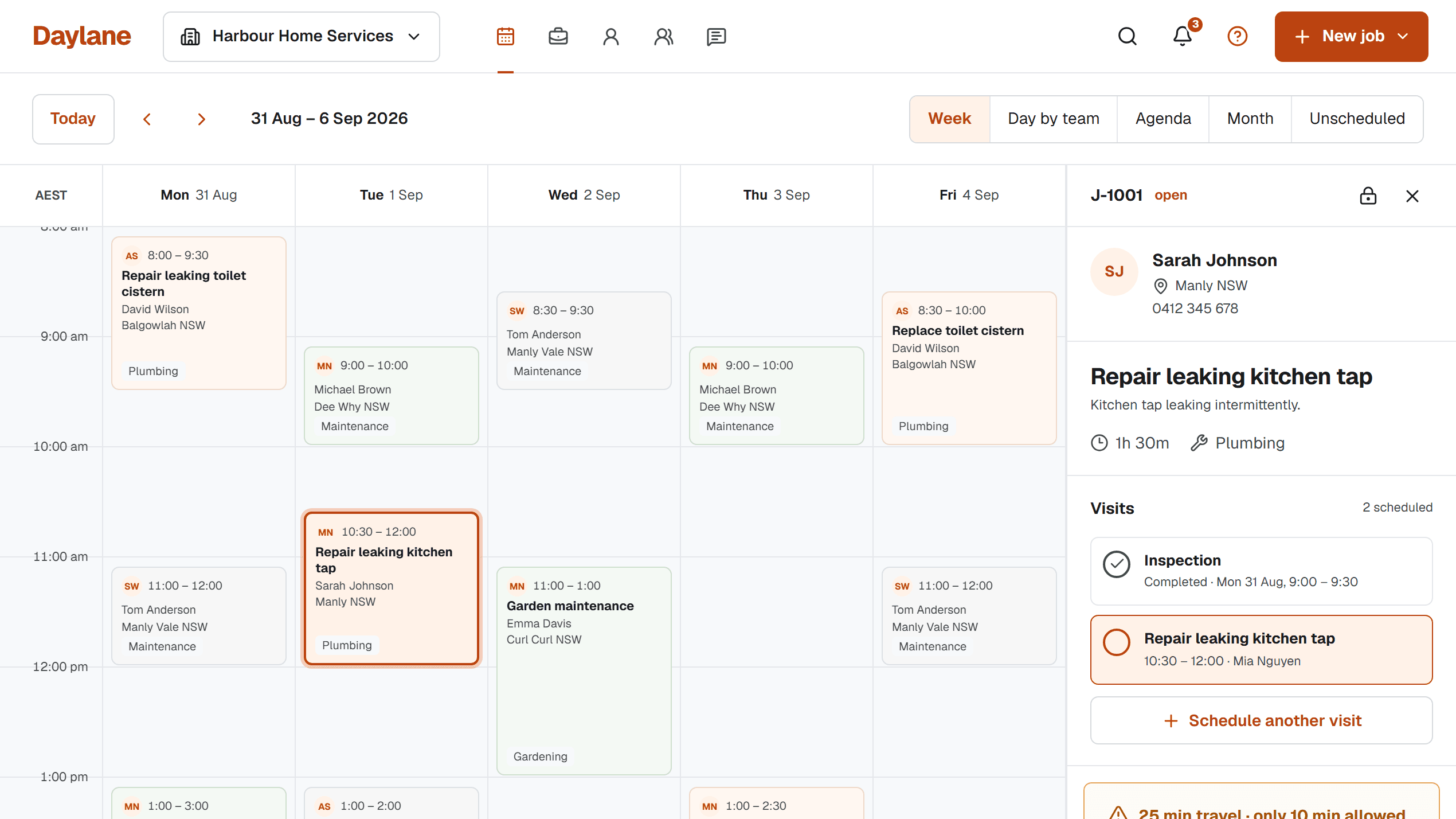
A two-person Visit is one customer attendance with two people's time committed. Check both calendars, agree who coordinates the Visit, and allow for each person's travel. Counting the work once in the customer schedule and twice in person-time keeps capacity estimates understandable.
Define who is needed and for how long
Establish whether both people are required for the whole Visit or for an overlapping part. Use your normal work and safety requirements to make that decision. A scheduling tool cannot determine the staffing needed to perform a task safely.
If attendance differs, record the plan clearly enough that the first person does not expect help before it is due. Check the actual assignment controls available rather than assuming the software supports every kind of staggered attendance.
Calculate time for each person
In a sample plan, two people attend one site from 10 am to noon. That is one two-hour Visit and four person-hours on site. If one travels 20 minutes and the other 40, their occupied time differs even though the customer sees the same attendance.
Do not assume two people complete every task in half the time. Setup, access and dependencies may not shorten with headcount. Estimate the planned work from the actual method and experience.
Check conflicts before confirming
Review both people's existing Visits and availability, including travel from their previous Locations. A person whose previous Job ends at 10 cannot arrive at another site at 10 without a travel allowance.
- Confirm the required people are available for the planned attendance.
- Check travel into and out of the shared Visit for each person.
- Choose a lead contact for customer updates and the Job outcome.
- Make equipment and access responsibilities explicit.
- Check changes against every assigned person's schedule.
Keep one Job history
Daylane supports multiple Visit Assignments and Pro+ team dispatch. Keep the attendance under one Job with the relevant people assigned. Creating two independent Jobs for the same work can leave different scopes, dates and completion decisions.
After a change, confirm that everyone sees the revised Visit. At completion, the lead should ensure the notes explain the overall outcome and any remaining work. Team access and dispatch help coordination; they do not replace the conversation about who is responsible for the next action.
Sources and scope
An original operational guide from the Daylane team at Blu Mint Digital. Scenarios, durations and message wording are illustrative planning examples, not customer results or industry benchmarks. Product references were checked against the Daylane implementation on 5 September 2026. Adapt the workflow to your service, customer agreements and working conditions.
How we write and maintain our guides. Free templates and planning tools.