
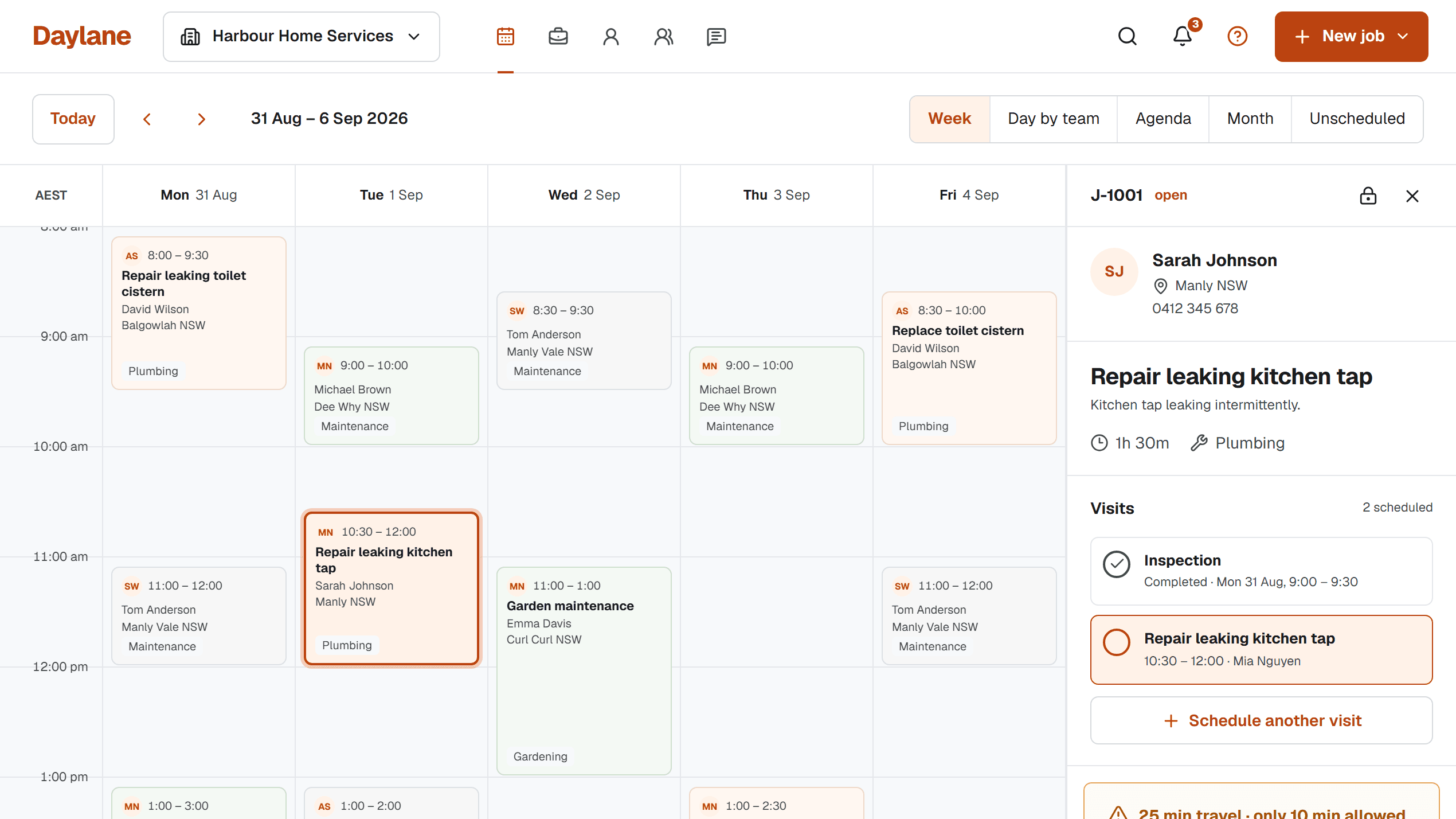
Check each person's timeline separately before confirming a shared Visit. The Visit can fit one participant and conflict with another. A shared block on the calendar does not mean that all participants have the same starting point, working hours or next commitment.
Build a row for each participant
The fictional shared Visit is planned for 10:00–11:30. Alex can reach it on time. Sam's previous Visit ends too late once travel is included, even though it does not overlap the shared Visit's start on paper.
| Person | Previous Visit ends | Inbound travel | Earliest arrival |
|---|---|---|---|
| Alex | 09:00 | 20 minutes | 09:20 |
| Sam | 09:45 | 30 minutes | 10:15 |
Resolve the missing time explicitly
Options include moving the shared Visit, changing the preceding work or choosing another suitable participant. Do not silently plan for Sam to arrive late if the work requires both people from the start. Agree the attendance requirement with the person responsible for scope.
Check the next journey for each person too. A shared service ending at 11:30 can still create different conflicts at noon depending on where each participant goes afterwards.
Review assignment changes as new scheduling decisions
Daylane supports one primary and up to four additional assignees. Saving a different set of people is not proof that all their routes have been assessed. Recheck availability and adjacent Visits after each material assignment change.
Tell the team which arrangement is current and who coordinates the attendance. The primary person should know whether everyone is required for the full duration and what to do if one participant cannot reach the site as planned.
Sources and scope
An original operational guide from the Daylane team at Blu Mint Digital. Scenarios, durations and message wording are illustrative planning examples, not customer results or industry benchmarks. Product references were checked against the Daylane implementation on 5 September 2026. Adapt the workflow to your service, customer agreements and working conditions.
How we write and maintain our guides. Free templates and planning tools.