
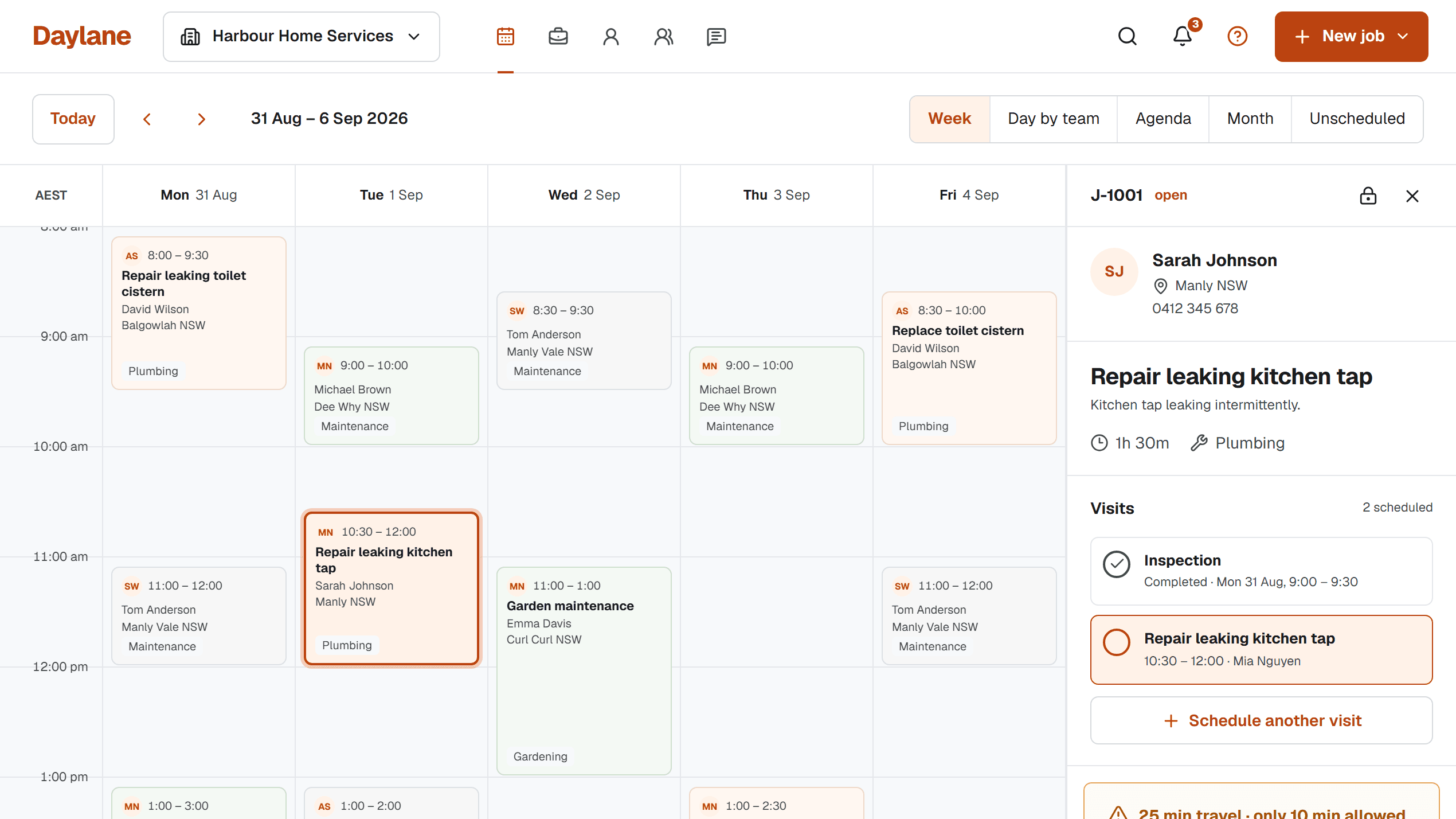
Ending a recurring service requires two reviews: stop new work being generated and resolve work that already exists. Confirm the last required service and any outstanding follow-up. A pause control alone does not mean the calendar is clear or the customer has been informed.
Confirm the final service decision
Record whether the customer wants one last attendance, an immediate stop or a temporary pause with a review date. These outcomes should not share an ambiguous note such as 'cancel regular'. Check any work still open from an earlier occurrence separately.
| Layer | Decision to record |
|---|---|
| Customer agreement | Final service date or immediate stop |
| Future generation | Pause the recurrence or review its end date |
| Existing Jobs | Keep, cancel or finish each affected occurrence |
| Open follow-up | Owner and next action independent of the series |
Stop generation and inspect existing work
Daylane's Pause future generation control leaves Jobs already on the schedule unchanged. For a planned end, the recurrence form also has an optional Ends on date; review the resulting schedule and any protected occurrences after changing the pattern.
Completed, in-progress, multi-Visit, moved, reassigned or edited Jobs are preserved by future-pattern edits. Do not assume an end-date change removes every future commitment. Inspect those exceptions individually.
Close the customer and team handover
After saving the decisions, confirm which Visit remains and which future services will not take place. Tell anyone assigned to affected work, especially if they already have a printed or copied run sheet. Pattern edits do not automatically message customers.
Keep the service history so the final outcome remains understandable. If the customer later returns with a new request, review the current scope, access and timing before resuming the old recurrence or creating another one.
Sources and scope
An original operational guide from the Daylane team at Blu Mint Digital. Scenarios, durations and message wording are illustrative planning examples, not customer results or industry benchmarks. Product references were checked against the Daylane implementation on 5 September 2026. Adapt the workflow to your service, customer agreements and working conditions.
How we write and maintain our guides. Free templates and planning tools.