
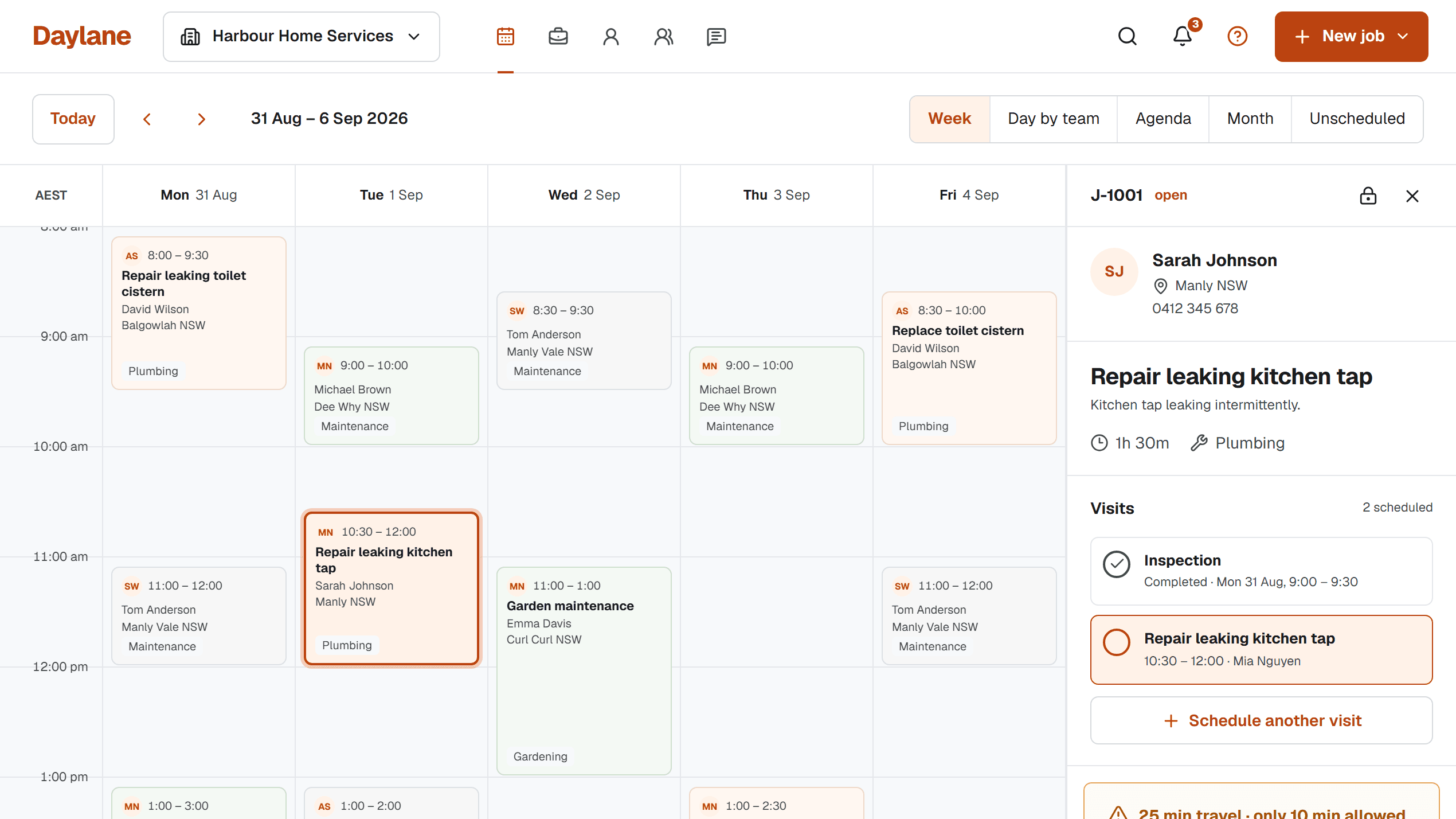
Record what the attendance achieved, what remains and what prevents the remaining work from proceeding. Finishing an attendance does not necessarily finish the Job. Keep the Visit outcome and the overall scope decision separate so the next person can see why follow-up is still needed.
Separate the three facts
The fictional example concerns a maintenance attendance with two approved tasks. One was completed; the other needs a part. Avoid a blanket note such as 'done' or 'not done', because each hides half of the outcome.
| Fact | Example wording |
|---|---|
| Completed work | First agreed task completed during this attendance |
| Remaining work | Second agreed task remains open |
| Blocker | Required replacement part not available |
| Next action | Scheduler to confirm part readiness before offering a return |
| Customer update | Explained which task remains and when the next update will come |
Use Visit progress without overstating Job completion
Daylane provides Start Visit and Complete Visit actions in the attendance workflow. Those progress actions update the Visit; they do not themselves establish that every agreed part of the Job is complete.
Record the factual outcome in the appropriate notes and review the Job's remaining scope before closing it. If another attendance is needed, plan a return on the same Job when it continues the agreed work.
Give the open work an owner
An open Job with no future Visit can be legitimate while a dependency is unresolved. It still needs a next action and reviewer. Do not book a placeholder return that looks confirmed when the required part or access is not ready.
At the next review, check the dependency and customer promise together. Once ready, prepare a return brief that states what was already completed so the next person does not repeat it.
Sources and scope
An original operational guide from the Daylane team at Blu Mint Digital. Scenarios, durations and message wording are illustrative planning examples, not customer results or industry benchmarks. Product references were checked against the Daylane implementation on 5 September 2026. Adapt the workflow to your service, customer agreements and working conditions.
How we write and maintain our guides. Free templates and planning tools.