
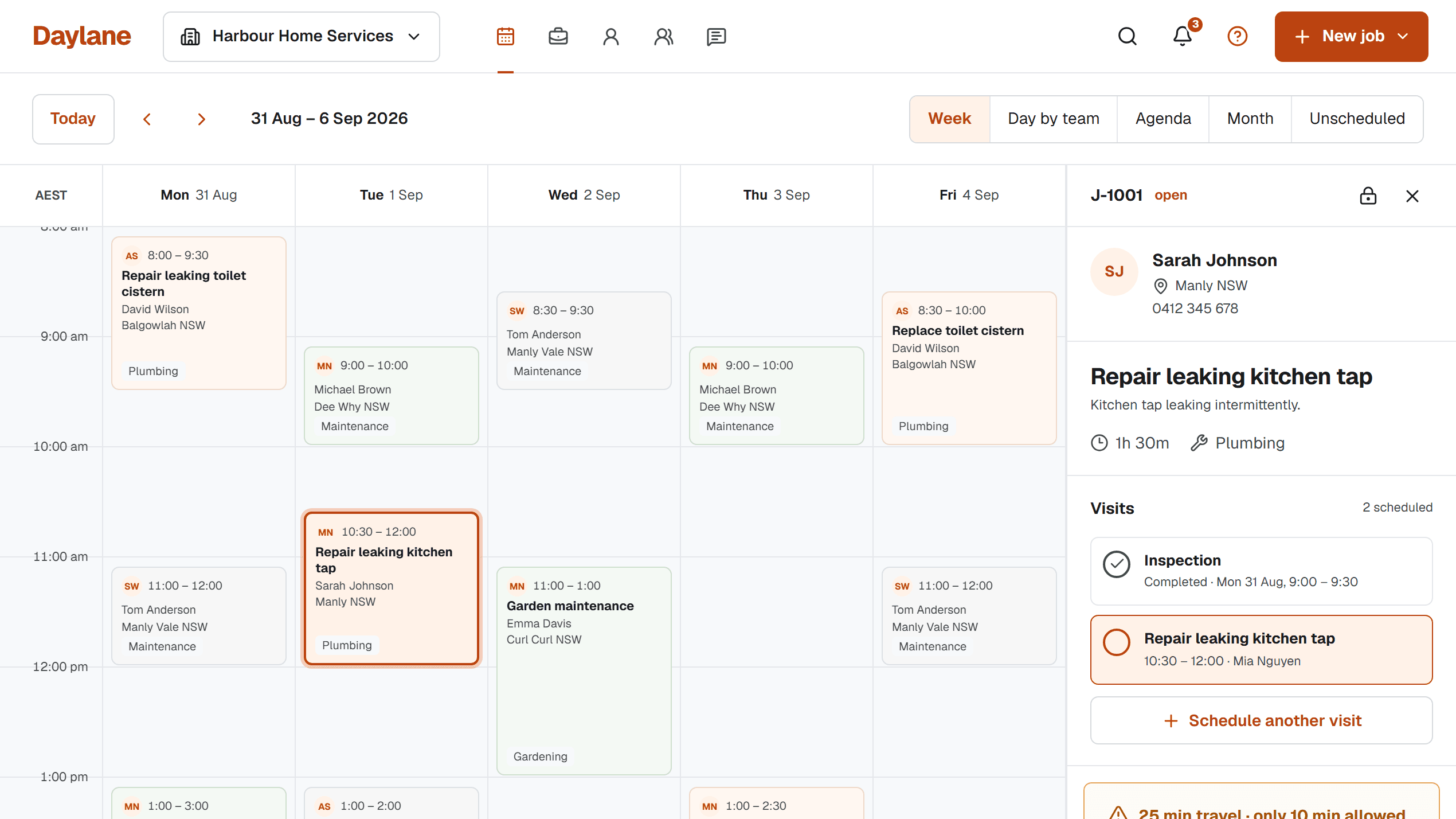
Ask a willing colleague to complete a small fictional Job setup and observe where they need to stop, guess or ask for help. Record the task and the assistance given. This guide is an observation protocol, not a claim that a user study has already been conducted.
Prepare a bounded practice task
Explain the purpose and agree how notes will be used before beginning. Use fictional customer details and avoid real customer notifications. Ask the person to set up one assessment at one Location, with a specified timing preference that still needs review.
| Step | Observe |
|---|---|
| Identify the Customer | Does the person know who commissions the work? |
| Choose the Location | Do they distinguish contact details from service address? |
| Describe the Job | Does the title match the agreed assessment? |
| Plan the Visit | Do they review duration, access and availability? |
| Verify the result | Can they find and explain the saved records? |
Record behaviour before explaining it
Note what the person did and what they said, distinguishing observation from your interpretation. If you help, record the prompt; an assisted completion is different from an independent one.
Avoid treating hesitation as proof that a particular screen is wrong. Ask a neutral follow-up such as 'What were you looking for there?' and compare the answer with the task and available view.
Turn findings into a specific change
A useful finding names the affected task, the point of confusion and the consequence. For example, choosing a contact address instead of a service Location suggests a different fix from misunderstanding an arrival window.
After changing wording, training or the workflow, repeat the affected task. Report the actual number of observations and their limitations if you share results; do not convert a small practice session into a broad usability claim.
Sources and scope
An original operational guide from the Daylane team at Blu Mint Digital. Scenarios, durations and message wording are illustrative planning examples, not customer results or industry benchmarks. Product references were checked against the Daylane implementation on 5 September 2026. Adapt the workflow to your service, customer agreements and working conditions.
How we write and maintain our guides. Free templates and planning tools.