
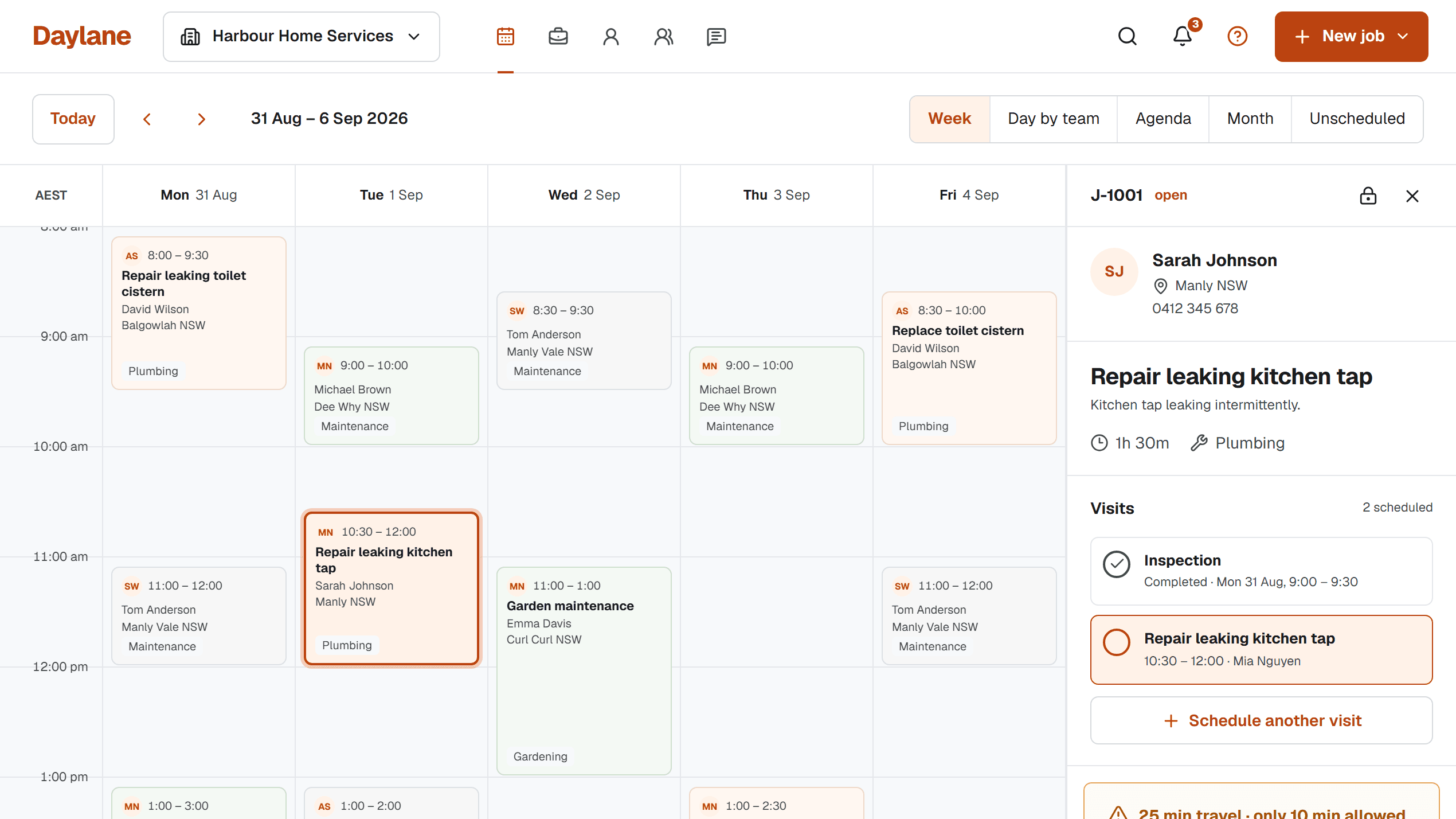
Train with a small, clearly labelled practice scenario and ask the colleague to explain the next decision in their own words. Showing where buttons are is useful, but understanding the Customer, Location, Job and Visit relationship is what prevents confusing records later.
Use one scenario across the session
Choose a fictional Customer with one Location and a Job that needs an assessment followed by a return. Avoid sending practice messages to real customers. Use the role the colleague will actually have, so the exercise reflects their available controls.
| Exercise | Ask the colleague to demonstrate |
|---|---|
| Find the work | Identify Customer, Location and Job reference |
| Read the attendance | Explain timing, scope and access |
| Handle a change | Describe who can reschedule and how to verify it |
| Record a partial outcome | Separate completed attendance from remaining Job work |
| Prepare a return | Name the blocker, owner and next Visit purpose |
Observe the point where context is lost
If the person cannot find an instruction, note the exact view and field rather than repeating the explanation faster. The issue may be a missing brief, a role boundary or an unclear label.
Have them explain what they would do if access failed or the scope changed at arrival. A workable answer includes the current record, the person to contact and the next decision, not a guess about how to proceed.
Agree a small set of working conventions
Choose conventions for Job titles, Visit instructions, factual outcome notes and unresolved follow-up. Keep them short enough to use during a real day. Review the first few handovers together and adjust the convention when it fails.
Do not claim the training proves every workflow is accessible or error-free. Record which tasks were completed, which required help and what should be tested again on the colleague's normal device.
Sources and scope
An original operational guide from the Daylane team at Blu Mint Digital. Scenarios, durations and message wording are illustrative planning examples, not customer results or industry benchmarks. Product references were checked against the Daylane implementation on 5 September 2026. Adapt the workflow to your service, customer agreements and working conditions.
How we write and maintain our guides. Free templates and planning tools.