
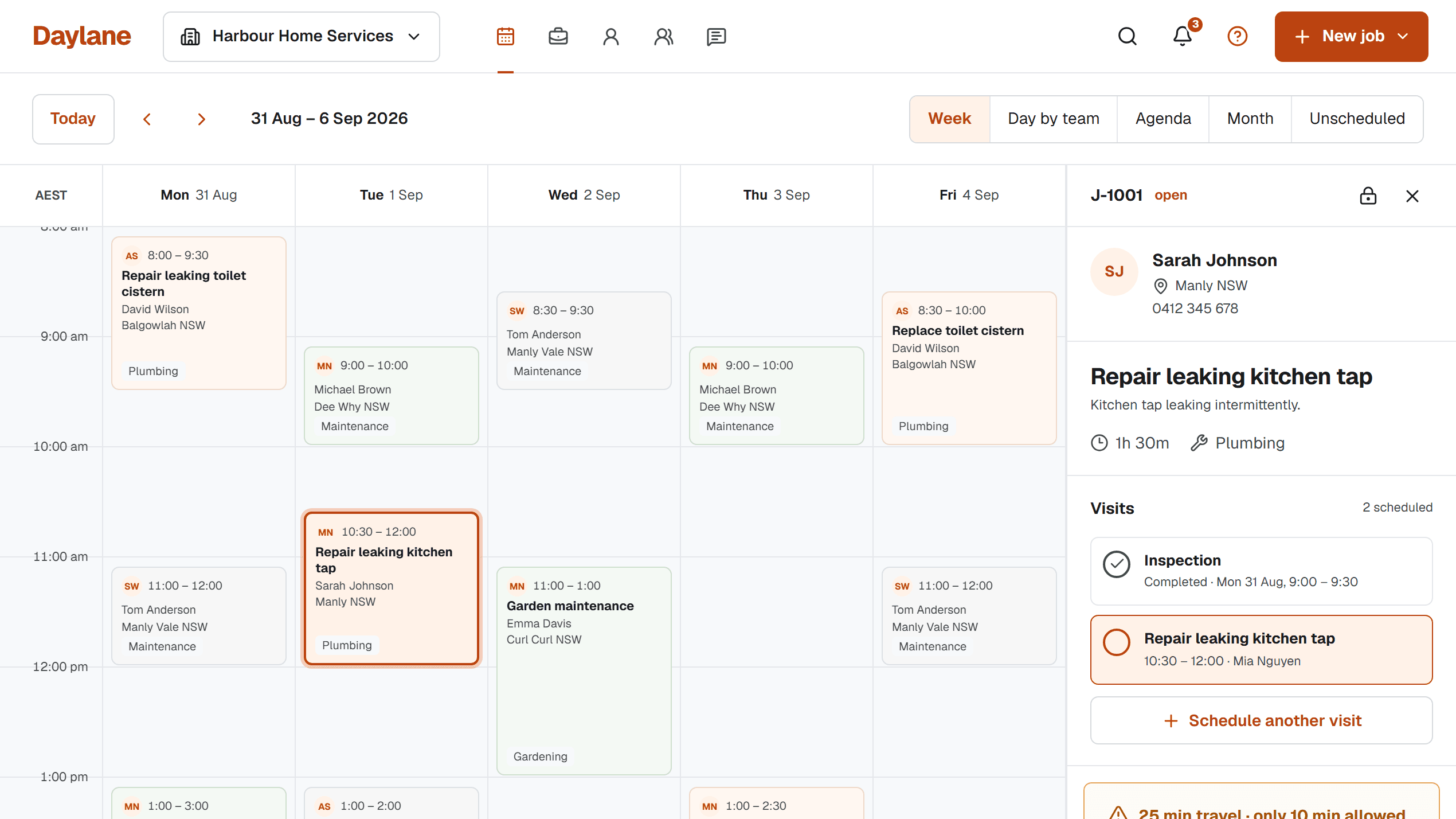
Job scheduling and appointment scheduling both put time on a calendar, but they solve different problems. Appointment tools usually help a Customer choose a service and available slot. Job scheduling starts with work the Business controls and keeps the operational details needed to deliver it. Knowing which model fits prevents you from forcing field work into a booking flow that loses important context.
Appointment scheduling begins with availability
An appointment system commonly publishes available times and lets the Customer select one. This suits consultations, salons, classes and other services where duration is predictable and the Customer's choice can create a confirmed booking. The calendar is the centre of the record.
That model becomes awkward when the work must be assessed, an assignee chosen, travel considered or parts arranged before a time is confirmed. A Customer can describe the problem, but the Business often needs to decide the duration and sequence.
Job scheduling begins with the work
A field Job connects the Customer, service Location, description, notes and lifecycle. One Job can contain an inspection, main attendance and return Visit. Each Visit has its own time and status while the Job provides the continuous history.
This distinction matters when something changes. Rescheduling Tuesday's Visit should not erase the Job, duplicate the Customer or hide the fact that another Visit already happened. The operational record remains stable while individual times move.
Customer requests can remain requests
Field businesses can still offer a convenient online request form. The important design choice is whether submission creates a request or silently confirms a Visit. Keeping it as a request lets the Business check service area, duration, access, travel and staff availability before committing.
The same principle applies to changes and cancellations. A Customer should have a clear way to ask, but the calendar should move only after the Business accepts the change or proposes an alternative. That protects both convenience and control.
Choose the category that matches your exceptions
The normal case can make almost any calendar look suitable. Compare the difficult cases instead: an urgent call-out, a return after parts arrive, work across two days, a Customer with several Locations and a Visit that needs two people. The right category is the one that handles those cases without workarounds.
If Customers genuinely choose standard slots, start with appointment scheduling. If the Business scopes and sequences work at Customer Locations, use a job calendar. Some businesses need both, but they should remain clear workflows rather than one ambiguous booking button.
Sources and scope
This practical guide was checked against the primary sources below on 1 September 2026. It is general information, not legal, tax, safety or accounting advice for your circumstances.
How we write and maintain our guides. Free templates and planning tools.