
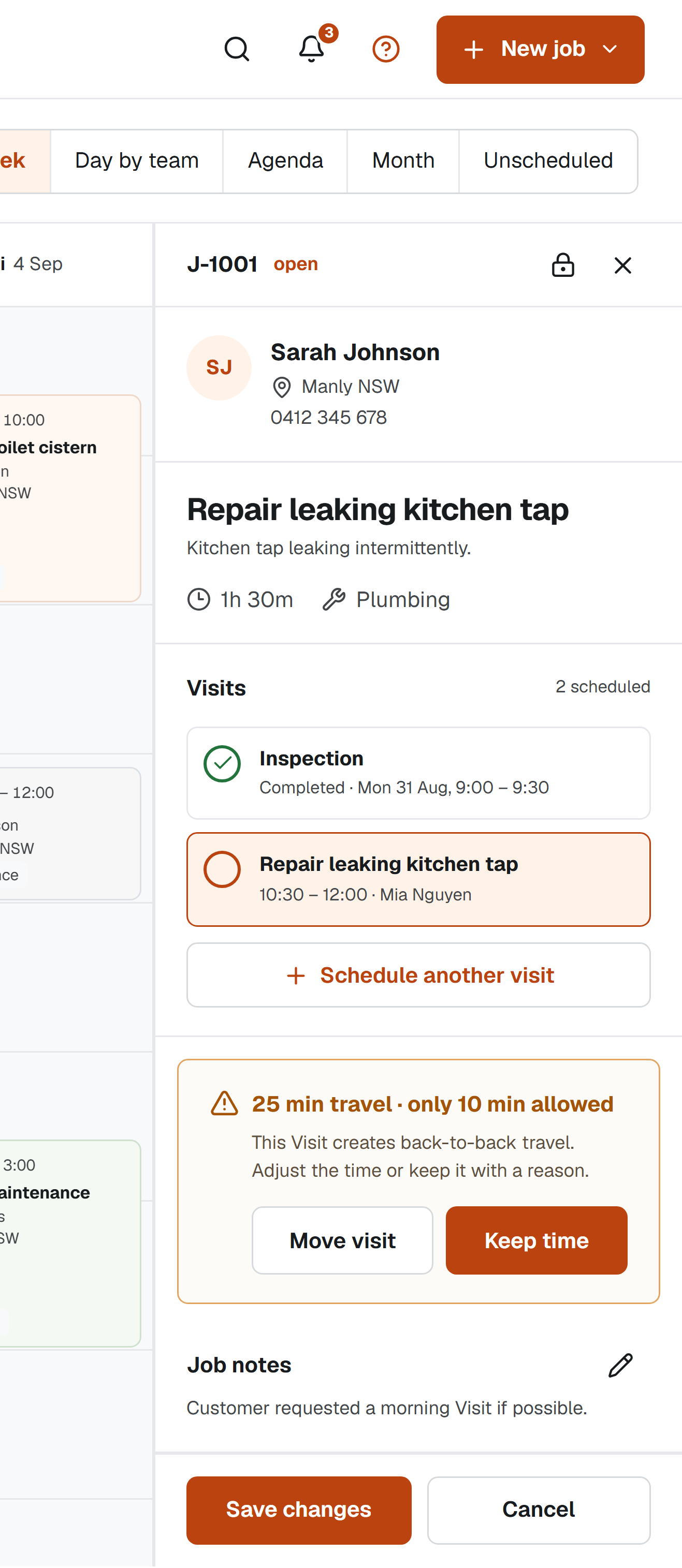
A good Job record answers the questions needed to arrive, complete the work and explain what happened. It should not become a dumping ground for every Customer detail. Organising information around the Customer, Location, Job and individual Visits makes the schedule more useful while supporting data minimisation.
Separate the Customer from the Location
The Customer is the person or business you communicate with. The Location is where the service happens. They are often the same address for residential work, but not always. A property manager may oversee several homes, and a business Customer may have multiple sites.
Keeping these records separate prevents duplicated Customer histories and makes navigation reliable. Store only the contact methods and access details you genuinely need, and make it clear which notes are Customer-visible and which are internal.
Let the Job describe the outcome
The Job title should identify the work in plain language: repair leaking kitchen tap is more useful than plumbing. Add the reported problem, agreed scope, Customer instructions and any photos that help prepare. A Job number can make conversations and invoices easier to reconcile.
Job status should answer whether the overall work is open, completed or cancelled. Do not use the Job status to describe today's attendance; that belongs to the Visit. This avoids closing work that still needs a return.
Let each Visit describe an attendance
A Visit needs a date, internal start time or Arrival Window, expected duration and assignee. It may also need visit-specific instructions, a travel buffer and completion notes. If the work moves, update the Visit while preserving the Job.
After attending, record the outcome in a way another person could understand later. Note what was done, what remains, relevant photos and the next agreed step. Short, consistent completion notes are more valuable than long free-form diaries that nobody can scan.
- Customer name and preferred contact method
- Verified service address and access instructions
- Specific Job title and description
- Visit time, duration and assignee
- Outcome, follow-up and completion evidence
Collect less, protect more
Customer names, contact details, service addresses and photos can be personal information. The Australian Privacy Principles include requirements around transparent handling, data quality and security. Even where a small-business exemption may apply, minimising collection is a sound operating baseline.
Avoid storing identity documents, payment details or unrelated personal notes in the scheduler. Set a retention practice, limit access to people who need the record and provide a way to correct inaccurate details. A lean Job record is easier to use and easier to protect.
Sources and scope
This practical guide was checked against the primary sources below on 1 September 2026. It is general information, not legal, tax, safety or accounting advice for your circumstances.
How we write and maintain our guides. Free templates and planning tools.