
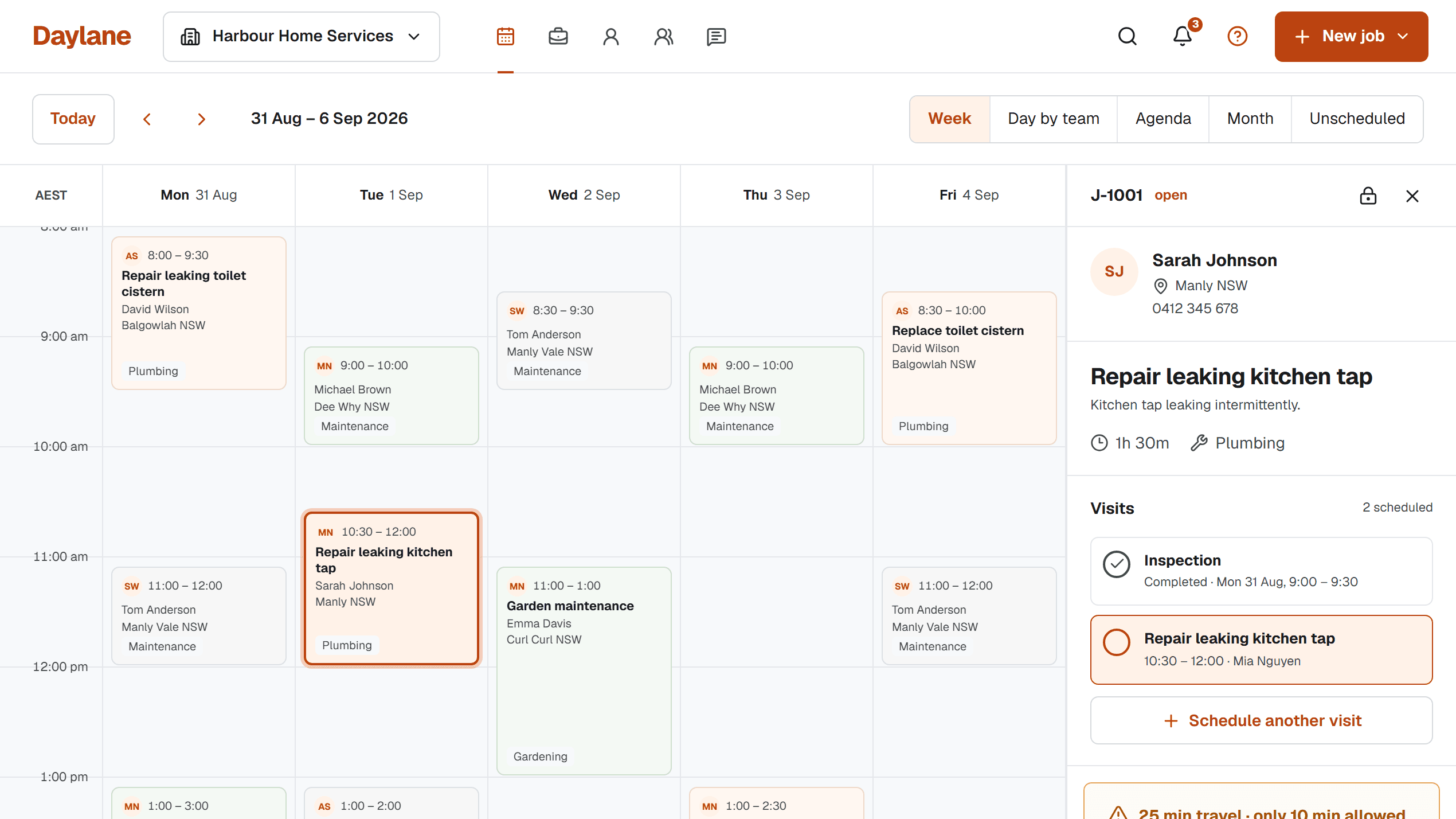
Job scheduling software should make the next working day easier to understand. For a sole trader, that usually means seeing the Customer, service Location, work, time and follow-up in one place. It does not automatically mean buying a large field-service suite. The right tool should fit the way you already accept and complete work, then remove the parts of that routine that cause double handling.
Start with the work, not the feature list
Write down how a real Job reaches your calendar. A Customer calls or messages, you capture the service address, decide what needs doing, choose a time and sometimes return later. A useful scheduling tool should preserve that chain. If it only stores a title and time, important details will continue to live in messages, notes and memory.
The first test is simple: can you schedule a genuine Job without configuring an entire business-management system? Look for quick Customer creation, service Locations, a clear calendar, notes that stay with the Job and support for more than one Visit. These are everyday scheduling needs, not premium administration features.
Separate essential scheduling from optional automation
Manual scheduling, rescheduling and Job history are the foundation. Automated reminders, online request forms, calendar synchronisation and SMS can save time later, but they should not be required to make the basic calendar useful. A product that makes core records dependent on automation can become expensive before it has improved the working week.
Also check the boundaries. If you already have an invoicing or accounting process that works, you may not need another quoting, payments or payroll module. A smaller job calendar can be easier to adopt because it changes one habit at a time and leaves the rest of the business alone.
- Customers and service Locations
- Jobs that can contain one or more Visits
- Week, day and mobile agenda views
- Clear rescheduling and cancellation history
- Export options so your records are not trapped
Check the mobile experience before committing
A desktop calendar can look excellent and still be awkward at a Customer's property. Test whether the phone view keeps the next Visit time, Customer, Location and instructions readable. Important actions should work through ordinary controls, not only drag-and-drop, because precision gestures are unreliable on a small screen and inaccessible to some users.
Browser-based software can work across desktop, Android and iPhone without requiring separate native apps. What matters is whether the provider has designed and tested the complete workflow responsively, rather than merely shrinking a desktop grid until the text becomes decorative.
Ask what happens when you leave
Before importing every Customer, find the export controls. You should be able to retrieve Customer and Job records in a common format, and the provider should explain retention and account deletion. The Office of the Australian Information Commissioner recommends that organisations collect only information reasonably needed for their functions and protect the personal information they hold.
The best choice is the tool that makes your real schedule clearer with the least new administration. Trial it with one normal week, one urgent Job and one return Visit. If those three cases feel natural, you have stronger evidence than a long feature comparison can provide.
Sources and scope
This practical guide was checked against the primary sources below on 1 September 2026. It is general information, not legal, tax, safety or accounting advice for your circumstances.
How we write and maintain our guides. Free templates and planning tools.