
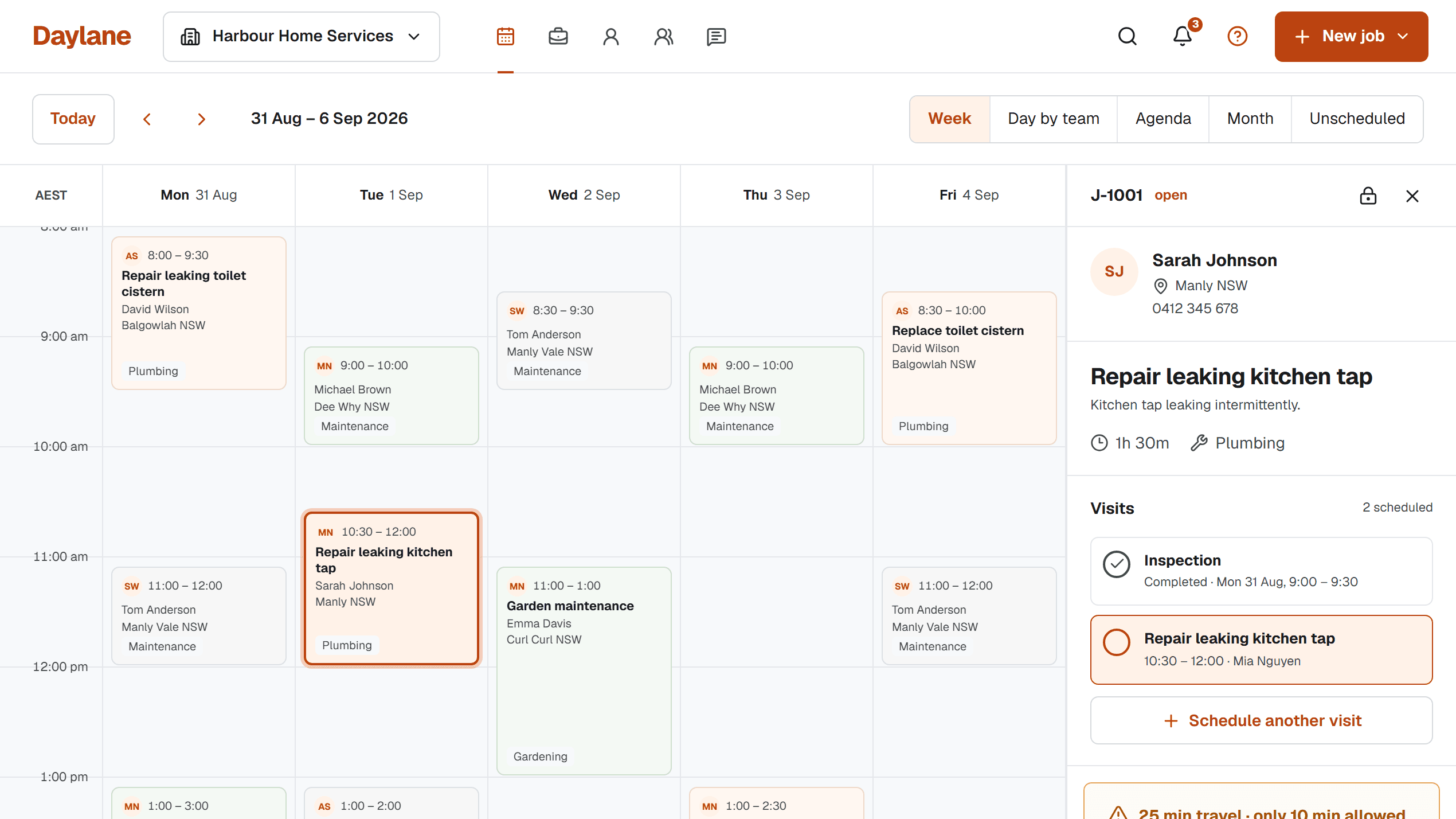
Count a shared customer attendance once when reporting Visits, and count each participant's time when reviewing capacity. Those measures answer different questions. Combining them into one total can make the business appear to have completed more customer attendances than it actually did.
Use two totals for the same day
This fictional day contains three customer Visits. One needs two people. The table counts scheduled service time only; travel, setup and breaks are added separately when reviewing each person's working day.
| Visit | Duration | People | Person-minutes |
|---|---|---|---|
| Office inspection | 60 minutes | 1 | 60 |
| Shared maintenance | 90 minutes | 2 | 180 |
| Return assessment | 30 minutes | 1 | 30 |
| Total | 180 Visit-minutes | 3 Visits | 270 person-minutes |
Add individual travel without changing the Visit count
If the shared maintenance needs 20 minutes of inbound travel for one person and 35 for the other, it consumes 55 additional person-minutes. It is still one customer Visit. Use a journey ledger to avoid counting the same person's leg twice.
A calendar reservation is planned occupied time, not a verified timesheet. Daylane's team workflow does not track attendance or live location. Label your review as planned capacity unless you have a separate, documented actual-time record.
Choose the measure that matches the decision
Use Visit count to reconcile customer attendances. Use person-time to understand how much team capacity a proposed day reserves. Use the Job outcome to determine whether the agreed work is complete.
If one person joins only part of an attendance, clarify the actual assignment and working arrangement before using a simple full-duration multiplication. State the assumptions alongside the total so another scheduler can interpret it correctly.
Sources and scope
An original operational guide from the Daylane team at Blu Mint Digital. Scenarios, durations and message wording are illustrative planning examples, not customer results or industry benchmarks. Product references were checked against the Daylane implementation on 5 September 2026. Adapt the workflow to your service, customer agreements and working conditions.
How we write and maintain our guides. Free templates and planning tools.