
Ask whether the customer wants to stop this attendance or arrange it for another time. 'I can't do Friday' does not settle that question. Confirm the intended outcome before changing the schedule, then decide separately whether the underlying Job still has work to complete.
Use the customer's intention to choose the action
A cancellation describes an attendance that will not happen as booked. It does not automatically establish that every part of the Job is finished or no longer wanted. A reschedule keeps the attendance purpose but changes its timing.
| Customer says | Clarifying question | Possible outcome |
|---|---|---|
| Friday won't work | Would you like another date? | Reschedule after a new time is agreed |
| We no longer need this clean | Is this occurrence only or the regular service? | Resolve occurrence and pattern separately |
| The inspection is done; cancel the return | Is the remaining work no longer required? | Record the assessment and remaining-scope decision |
Save the decision without inventing completion
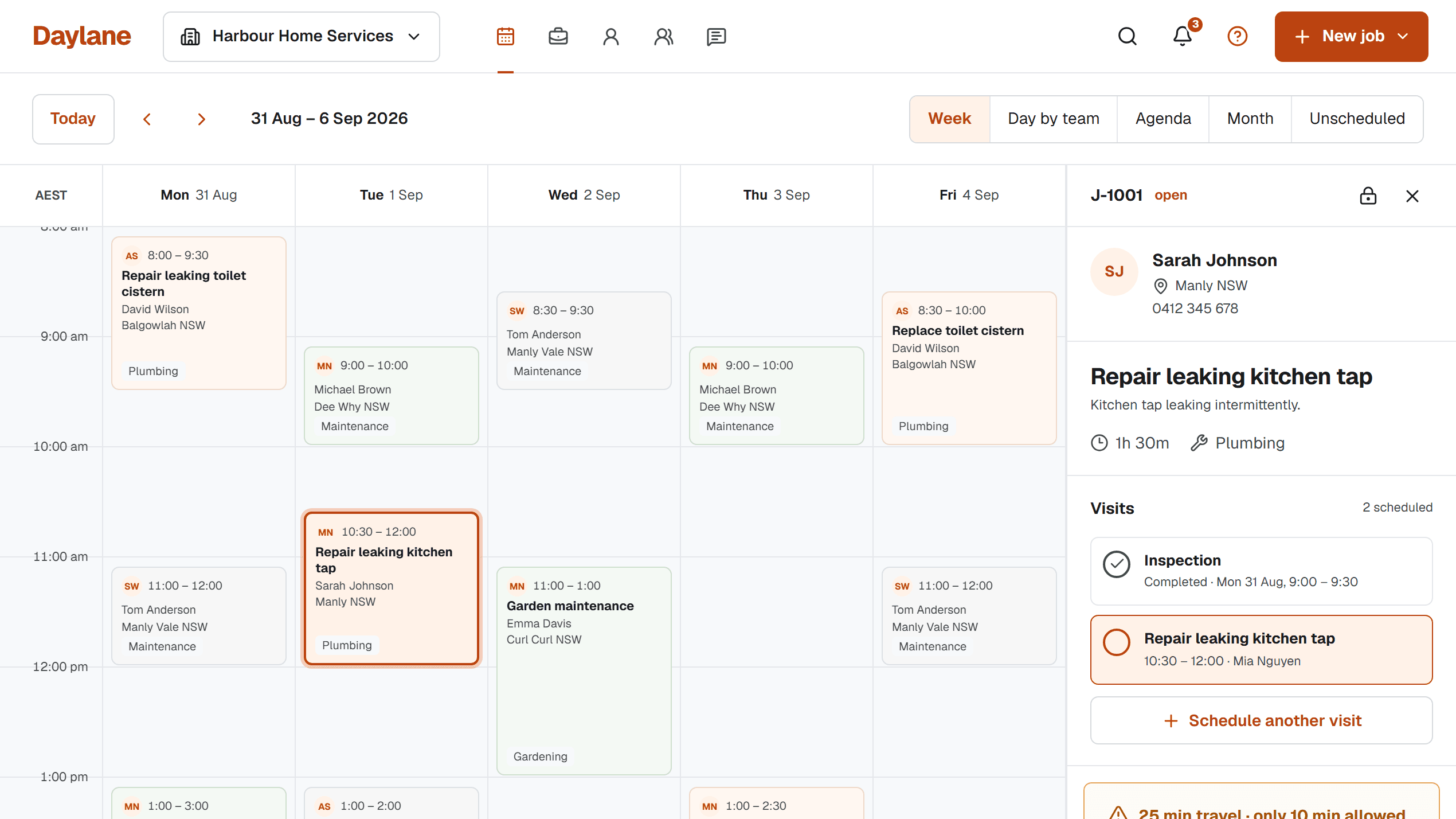
In Daylane, owners and schedulers can review customer change requests. A reschedule acceptance requires a new date and time and can be blocked by an assigned-Visit conflict. Check the current request status before acting.
After cancelling an attendance, review the Job's remaining scope and future Visits. Do not mark work completed simply to clear the calendar. Record what the customer declined or what still needs planning.
Confirm what happens next
Example: 'Friday's Visit will not go ahead. We are checking another date for the same inspection and will send a separate confirmation.' If the work is no longer required, say so accurately instead of promising another offer.
This guide concerns scheduling records and communication. Any fees or other terms should follow the actual customer agreement and your separate business process; do not infer them from a calendar status.
Sources and scope
An original operational guide from the Daylane team at Blu Mint Digital. Scenarios, durations and message wording are illustrative planning examples, not customer results or industry benchmarks. Product references were checked against the Daylane implementation on 5 September 2026. Adapt the workflow to your service, customer agreements and working conditions.
How we write and maintain our guides. Free templates and planning tools.