
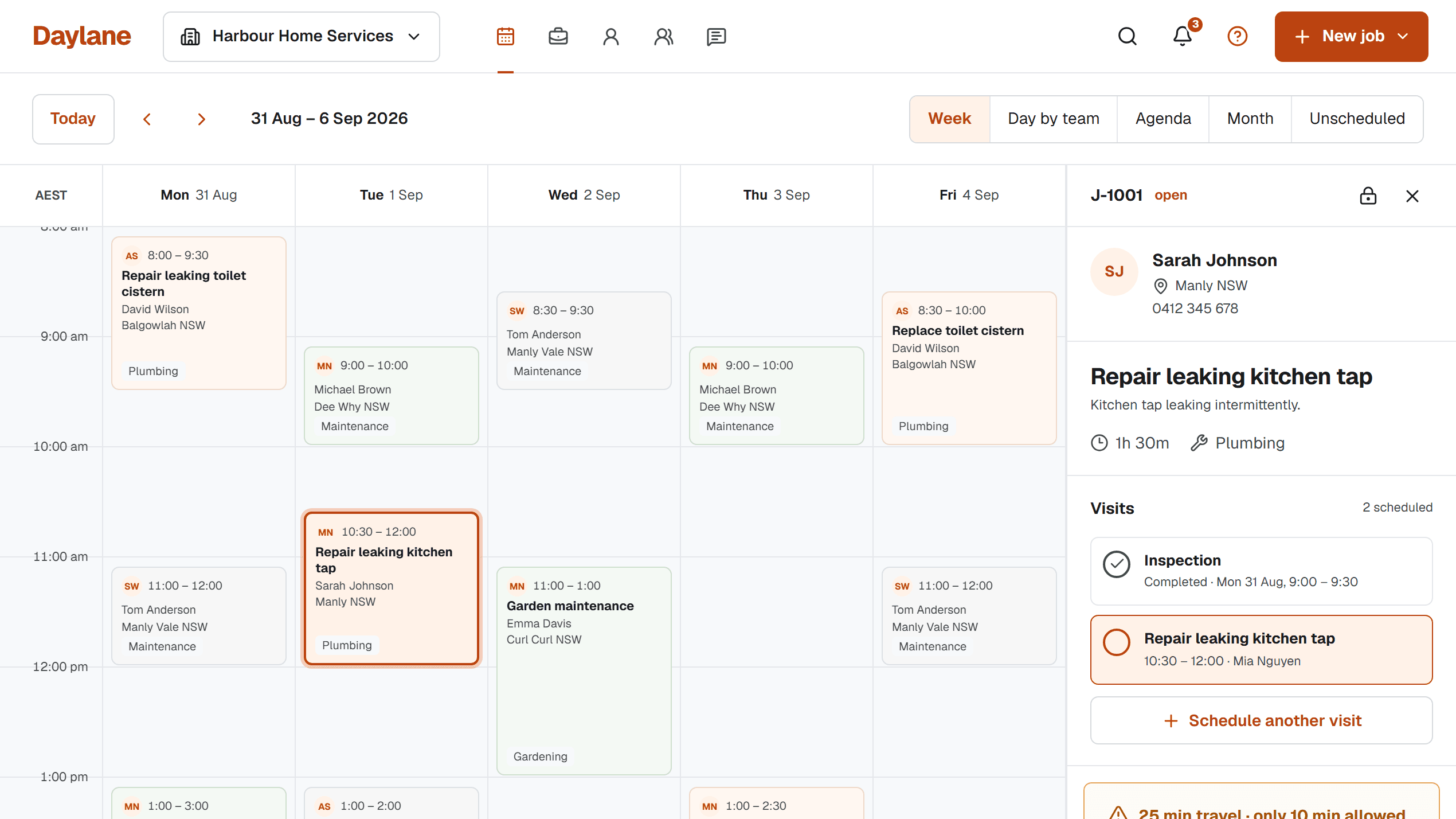
Use the actual occupied time of each Visit when a day contains different kinds of work. An average-based capacity estimate can tell you roughly how much work fits, but it cannot choose a feasible order. Place fixed constraints first, add travel between the proposed Locations, and protect the time reserved for breaks, administration and recovery.
Build the day from individual components
A short routine service, a longer maintenance Job and an assessment have different scheduling needs. Include setup in the on-site estimate or list it separately, but use the same convention throughout the plan. Check that each customer can accommodate the proposed attendance.
The following fictional day runs from 8 am to 4 pm. Its service durations already include setup and pack-up. The journeys are illustrative allowances, not estimates for real addresses.
| Time | Activity | Minutes |
|---|---|---|
| 8:00–8:20 | Travel to Visit A | 20 |
| 8:20–9:05 | Routine Visit A | 45 |
| 9:05–9:30 | Travel to Visit B | 25 |
| 9:30–12:00 | Longer Visit B | 150 |
| 12:00–12:30 | Break | 30 |
| 12:30–12:50 | Travel to Visit C | 20 |
| 12:50–14:05 | Assessment Visit C | 75 |
| 14:05–14:30 | Final travel | 25 |
| 14:30–15:00 | Administration | 30 |
| 15:00–16:00 | Recovery / uncommitted time | 60 |
Check the total, then check the sequence
The three Visits use 270 minutes on site. Travel occupies 90, the break 30 and administration 30, leaving 60 minutes uncommitted. The total is 480 minutes. That arithmetic is necessary, but it would not make the plan workable if Visit B could only be accessed before 9 am.
Changing the order means recalculating the relevant journeys. Do not move cards while leaving travel assumptions from the previous sequence in place.
Test an overrun before accepting more work
If Visit B takes another 30 minutes, Visit C may start later even though the day still ends within the available hours. Check the customer's arrival agreement, not just the remaining total. A buffer at the end of the day does not automatically protect a fixed midday commitment.
When offering a fourth Visit, calculate its complete effect on the sequence. The spare hour might be useful for administration or a ready nearby task; it does not necessarily fit an hour-long service plus travel.
Turn the example into your own run sheet
Replace the sample durations with the actual work, access constraints and journey estimates. Record why a Visit occupies its chosen place, especially when a site contact or material collection determines the order. Confirm the agreed times only after that review.
Sources and scope
An original operational guide from the Daylane team at Blu Mint Digital. Scenarios, durations and message wording are illustrative planning examples, not customer results or industry benchmarks. Product references were checked against the Daylane implementation on 5 September 2026. Adapt the workflow to your service, customer agreements and working conditions.
How we write and maintain our guides. Free templates and planning tools.