
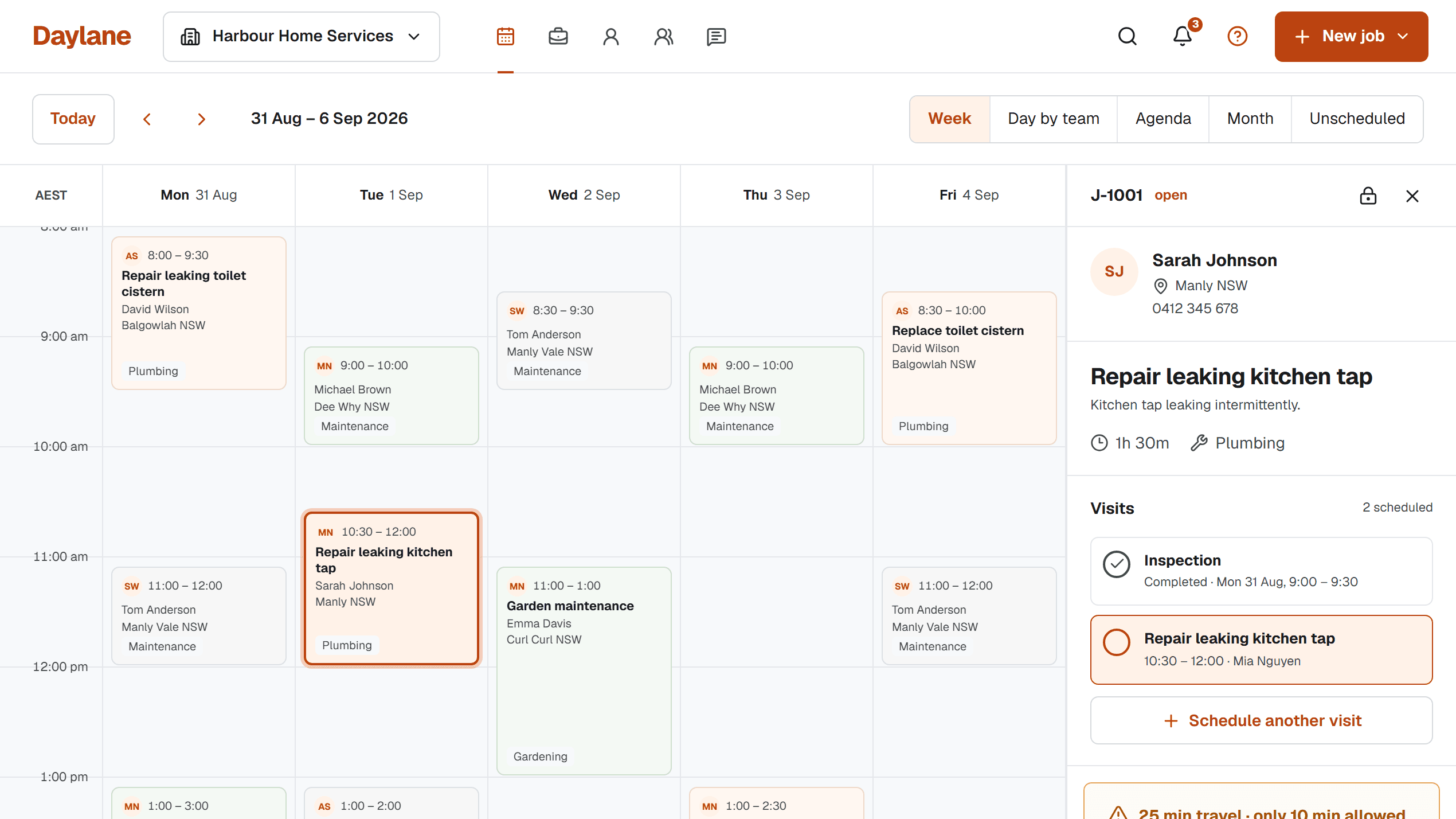
Reserve a larger block when the agreed work and plausible variation need it, not simply because you cannot explain the estimate. A half-day reservation should have a defined start, a planning end and a clear scope. It protects capacity for the work; it does not automatically tell the customer when you will arrive or what you will charge.
Define the block in actual times
'Morning' can mean different things to the customer and the scheduler. Decide which part of your working day you are reserving, and state an arrival time or window separately. Account for the journey before and after the site work.
If the customer must be available throughout the attendance, explain the expected time on site. An internal four-hour reservation should not become an unexplained four-hour arrival window.
Compare two plans for the same work
Suppose an illustrative maintenance Job starts at 8:30 am and needs between two and three hours on site, including setup. The next property is 30 minutes away. The following table shows why a short plan can fail even when the central estimate looks reasonable.
| Plan | Next Visit | If first work ends at 11:30 |
|---|---|---|
| Reserve two hours on site | 11 am | Arrival at noon misses the commitment |
| Reserve the longer on-site scenario | Noon | 30-minute journey fits; no extra recovery remains |
Reserve uncertainty without concealing the scope
The second plan protects the illustrated variation, but it still has no recovery between an 11:30 finish and noon arrival. Add a separate allowance if the circumstances require it. Do not present a larger booking as proof that an unknown Job must finish inside that block.
If the customer adds work, review the remaining time and the following commitments before accepting it. Explain which tasks can proceed and which need a separate agreement or return. A larger reservation is not permission to expand scope indefinitely.
Review how larger blocks are used
When work finishes early, use the remaining time only for a Job that is ready and genuinely fits. Check travel, customer availability and the later schedule before offering an earlier Visit.
Review several comparable reservations. If they are consistently too generous, improve the estimate. If the extra time is regularly consumed by unplanned material collection, address that dependency before reducing the booking length. The scheduling decision and the customer's pricing agreement remain separate matters.
Sources and scope
An original operational guide from the Daylane team at Blu Mint Digital. Scenarios, durations and message wording are illustrative planning examples, not customer results or industry benchmarks. Product references were checked against the Daylane implementation on 5 September 2026. Adapt the workflow to your service, customer agreements and working conditions.
How we write and maintain our guides. Free templates and planning tools.