
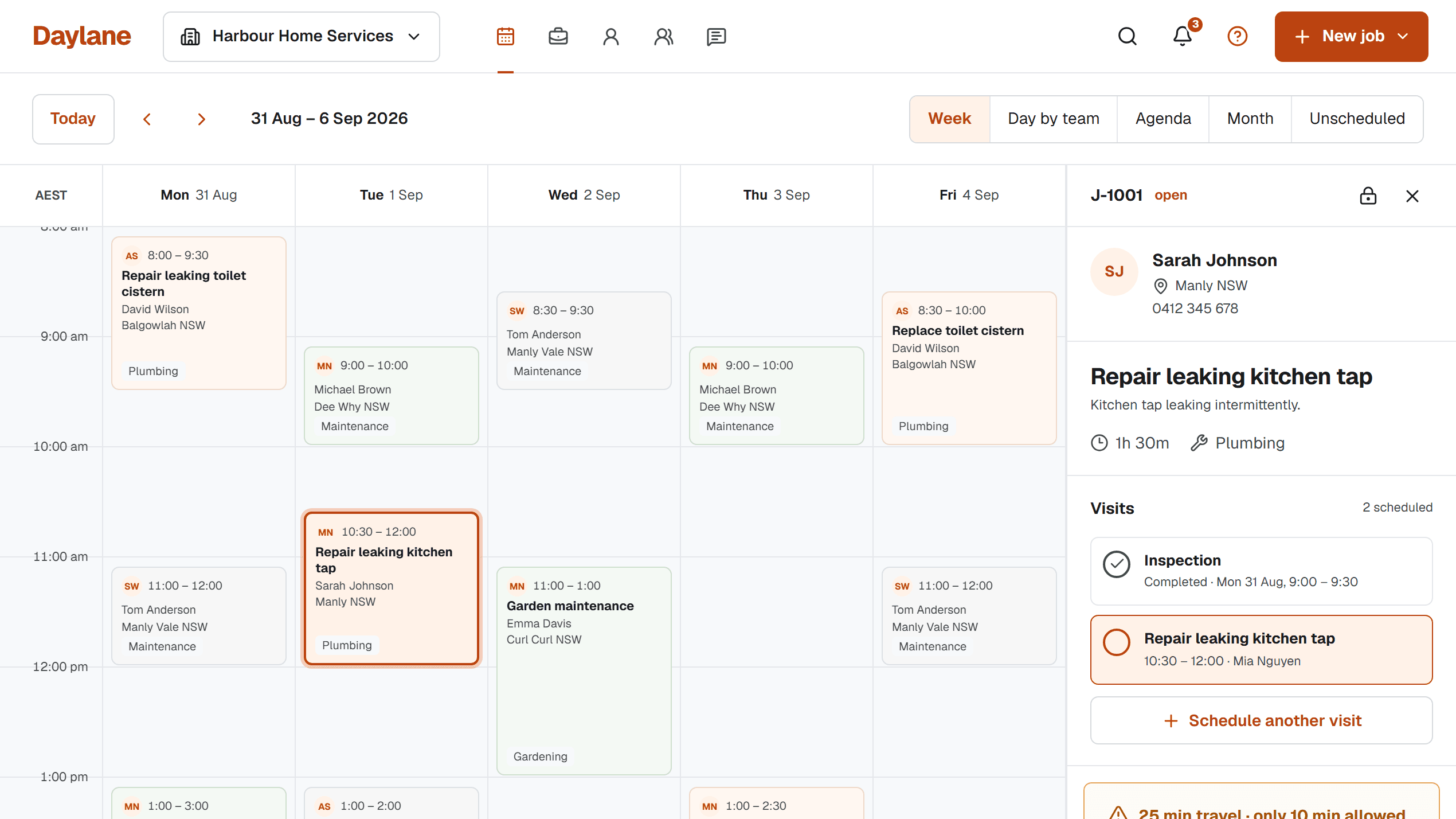
A cancellation creates available time, not necessarily a usable booking slot. Check the gap between the surrounding commitments, identify work that is ready, and offer an earlier time to one suitable customer. Confirm the replacement before treating the time as occupied.
Measure the opening between real commitments
If a 10 am Visit is cancelled, the usable opening begins when you can leave the previous Job and ends when you must depart for the next. Travel to a replacement property may differ substantially from the cancelled journey.
For example, a 90-minute gap with 20 minutes to the replacement site and 25 minutes onward leaves 45 minutes on site. A one-hour service will not fit, even though the calendar appears to offer an hour and a half.
Choose work that is ready
Look for confirmed scope, available materials and a customer who has indicated that an earlier Visit would help. Avoid repeatedly contacting customers who can only meet at the original time. Keep any flexible-booking preference in a place you will see during scheduling.
For a return Visit, verify the outstanding issue can now be addressed. A cancellation is not a reason to attend before a required part arrives or before the right team member is available.
Make an offer with a clear expiry
Offer the specific earlier window and explain that their existing booking remains unchanged unless they accept. If you need an answer by a particular time, say so. Do not promise the same opening to several customers simultaneously.
- Example: Hi Morgan, an earlier Visit is available tomorrow between 10 and 11 am. Would that suit you?
- Your current Friday booking stays in place unless we agree to move it.
- Please reply by 3 pm today so I can confirm tomorrow's schedule.
Check both ends of the move
After acceptance, update the Visit, confirm the new window and review the slot that has now opened on the original day. Moving the existing Visit keeps the work history together and avoids leaving a duplicate attendance in the calendar.
If no suitable Job fits, use the time for a real backlog action, equipment preparation or administration. Filling every blank space is less valuable than maintaining a schedule you can deliver. Record why the gap could not be used if this happens often; it may reveal a travel or booking-pattern problem.
Sources and scope
An original operational guide from the Daylane team at Blu Mint Digital. Scenarios, durations and message wording are illustrative planning examples, not customer results or industry benchmarks. Product references were checked against the Daylane implementation on 5 September 2026. Adapt the workflow to your service, customer agreements and working conditions.
How we write and maintain our guides. Free templates and planning tools.