
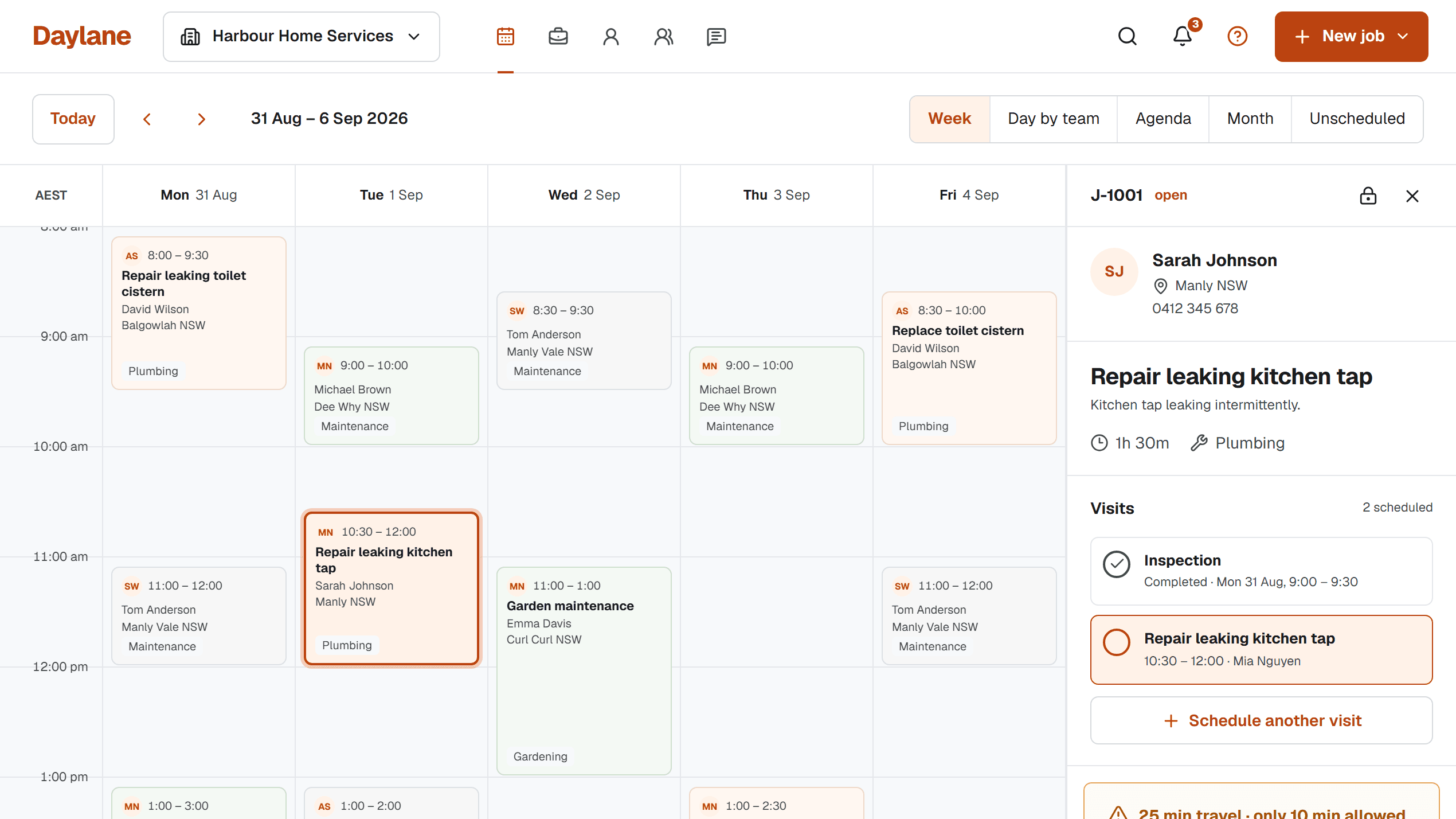
A Booking Request asks the business to review proposed work and timing. A confirmed Visit is an agreed attendance on the schedule. Daylane's request form explicitly says the preferred time is not a confirmed appointment, so your surrounding messages should preserve that distinction.
Explain the three stages
The request form is available through Daylane's Pro+ Booking Request Page. It collects a name, email or phone, service address, description and preferred date/time window. Choosing a service type helps describe the request; it does not reserve a calendar opening.
| Stage | What it establishes | What still needs deciding |
|---|---|---|
| Form submitted | The business has a request to review | Scope, access and capacity |
| Business offers a Visit | A concrete proposed arrangement | Customer agreement where needed |
| Visit confirmed | The saved attendance and communicated expectation | Any later change must be reviewed |
Match the acknowledgement to the actual process
Useful wording is: 'We will review the work and your preferred time, then contact you about a suitable Visit.' Only promise a response deadline your business can meet. Avoid a headline such as 'Your slot is reserved' when the form merely sends a request.
Daylane displays Request sent after a successful submission. Review the saved request before promising attendance, and check for an existing Job if the same customer has contacted you through another channel.
Confirm the details the form cannot decide
The customer's preferred window does not establish how long the work takes, whether materials are ready or which person can attend. Clarify those details before converting the request into a scheduled commitment.
When the Visit is agreed, state the service Location, purpose and arrival expectation. If the requested time cannot work, offer a specific alternative or explain the next step rather than leaving the request indefinitely ambiguous.
Sources and scope
An original operational guide from the Daylane team at Blu Mint Digital. Scenarios, durations and message wording are illustrative planning examples, not customer results or industry benchmarks. Product references were checked against the Daylane implementation on 5 September 2026. Adapt the workflow to your service, customer agreements and working conditions.
How we write and maintain our guides. Free templates and planning tools.