
Record who commissions the work, who handles billing and who can provide access before confirming attendance. One person may fill all three roles, but a property manager, business customer or shared premises can involve several people. Name each responsibility explicitly so a scheduling message reaches the right person.
Ask who can make each decision
A person who can unlock the building may not be able to approve extra work. Ask the commissioning customer who can authorise scope changes, where your separate invoicing process should send the bill, and who will meet the person attending. Confirm the preferred route for an arrival update rather than assuming the billing email is also the access contact.
| Responsibility | Named contact | Use for |
|---|---|---|
| Work approval | Alex, property manager | Scope changes and permission to proceed |
| Billing | Example accounts team | Invoice delivery through the business's invoicing process |
| Site access | Sam, reception | Meeting the attending person at the agreed entrance |
Use labelled notes without inventing contact fields
Daylane's Customer record has a name, email, phone and internal notes. It does not provide separate dedicated billing-contact and access-contact records in that form. Use clear role labels in relevant internal notes and keep invoicing details in your invoicing process.
The Customer form describes its contact details as being used for scheduling messages. Changing that email to an accounts inbox therefore deserves a scheduling review. A note containing another email does not make that person an automatic message recipient.
Give the attending person the relevant arrangement
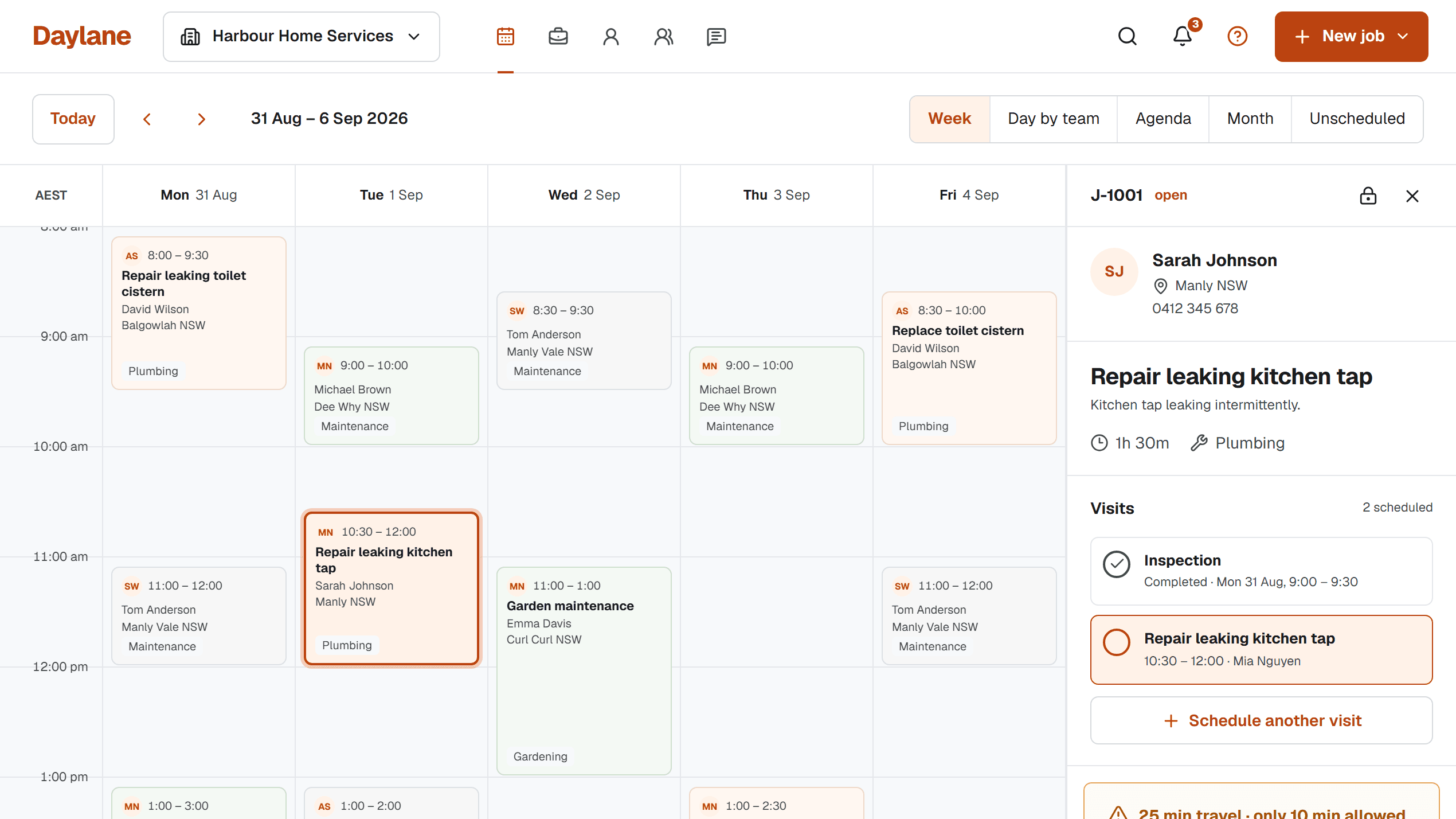
Prepare a Visit instruction such as: 'Meet Sam at reception. Alex approves any additional work; contact the scheduler before proceeding beyond the agreed inspection.' Add only the contact details needed for that attendance and verify them with the customer.
Check the actual Visit view available to the assigned person. Do not assume a Location note or a billing note will automatically appear there. Keep customer-facing instructions suitable for the shared Visit page.
Confirm the arrangement again when people change
Use a short confirmation: 'For Tuesday's Visit, is Sam still meeting us at reception, and should any scope change go to Alex?' Update the affected record and tell anyone relying on an earlier brief. This is a manual coordination step; editing a note alone does not establish that the other person has seen it.
Sources and scope
An original operational guide from the Daylane team at Blu Mint Digital. Scenarios, durations and message wording are illustrative planning examples, not customer results or industry benchmarks. Product references were checked against the Daylane implementation on 5 September 2026. Adapt the workflow to your service, customer agreements and working conditions.
How we write and maintain our guides. Free templates and planning tools.