
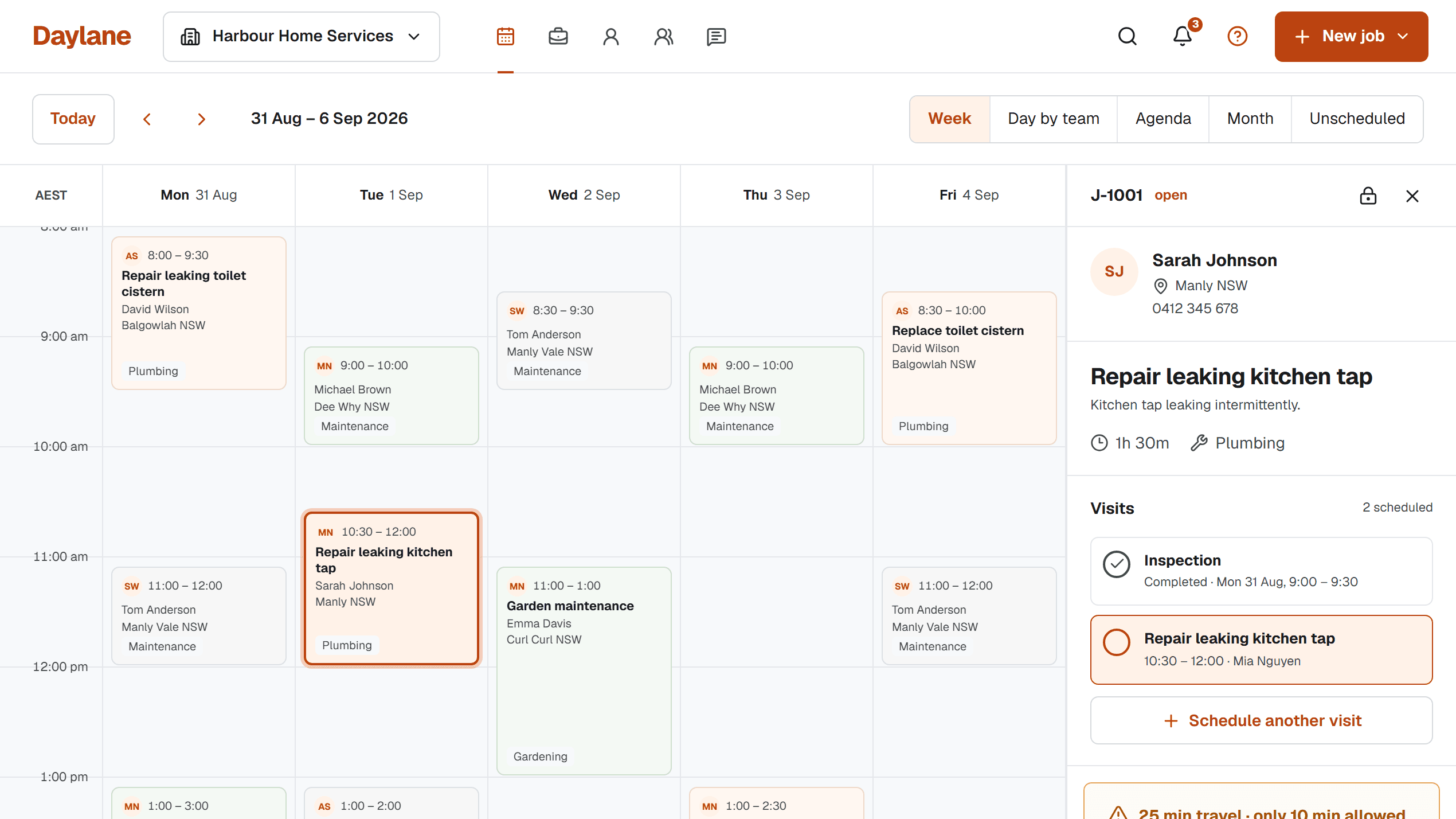
The arrival window describes when the customer should expect arrival. The internal start and duration reserve working time in the schedule. Review them together: an arrival window can be correctly worded while leaving too little service time before the next commitment.
Test the latest arrival against the work duration
Suppose a Visit reserves 10:00–11:30 and requires 90 minutes of service. An arrival window of 10:00–10:30 means arrival at 10:30 could extend the work to noon. The table shows why the reservation and customer promise need to be reconciled.
| Scenario | Start | 90-minute finish |
|---|---|---|
| Arrival at window opening | 10:00 | 11:30 |
| Arrival at window closing | 10:30 | 12:00 |
| Next Visit at 12:00 with 20-minute travel | Depart by 11:40 | Latest-arrival scenario does not fit |
Choose a workable combination
Options include narrowing the arrival promise, reserving a larger service slot or moving the next Visit. Choose based on what the customer and schedule can support. Do not solve the mismatch by silently assuming less work will be needed.
In Daylane's scheduling form, review Internal start, Expected duration and both Arrival Window fields. Inspect travel and access as well; a later arrival may miss reception even if the service can finish later.
Compare the customer and internal views
The shared Visit page displays the arrival window when both endpoints are supplied; otherwise it uses the scheduled start/end information. The private Visit contains the scheduling detail your team uses. Review both before sending the link.
If the arrangement changes, update the saved fields and communicate the new expectation. A revised internal start alone should not leave the customer relying on an old arrival promise.
Sources and scope
An original operational guide from the Daylane team at Blu Mint Digital. Scenarios, durations and message wording are illustrative planning examples, not customer results or industry benchmarks. Product references were checked against the Daylane implementation on 5 September 2026. Adapt the workflow to your service, customer agreements and working conditions.
How we write and maintain our guides. Free templates and planning tools.